Skip to content




Effective phishing protection must extend beyond email, firewalls, and employee training. Attackers now impersonate brands through fake websites, social accounts, paid ads, lookalike domains, and other external channels that traditional internal security tools cannot control.
Phishing protection is the process of detecting, preventing, investigating, and removing phishing threats before they can steal credentials, money, or sensitive information.
Imagine a customer searching for your company online.
They click what appears to be your website. The logo is correct. The colors match. The product photography looks familiar. Even the login page feels genuine.
There is only one problem.
The website does not belong to you.
For many security teams, that scenario exposes a major gap in traditional phishing protection.
Firewalls protect the network. Email filters block suspicious messages. Endpoint tools protect employee devices. Training helps employees recognize threats.
All of those controls remain essential.
However, none of them can take down a fake website hosted on infrastructure your company does not control.
That is why phishing is increasingly becoming both a cybersecurity problem and a brand protection problem.
Key Takeaways
- Phishing protection cannot stop at the corporate perimeter. Fake domains, websites, social accounts, and ads often sit outside company-controlled systems.
- Phishing remains a growing external threat. APWG reported a 10.1% increase in phishing attacks during Q2 2026.
- Brand impersonation creates real financial risk. The FTC reported more than $3.5 billion in imposter-scam losses during 2025.
- Attackers increasingly target customers as well as employees. A brand’s identity can become the lure.
- Detection is only the first step. Organizations need fast validation, investigation, and takedown.
- Connected threat analysis matters. One phishing site may be part of a wider network of domains, ads, profiles, and other malicious assets.
Why Does Phishing Protection Need to Go Beyond Email?
Phishing protection needs to extend beyond email because attackers now reach victims through websites, search results, social media, paid advertising, messaging apps, and lookalike domains. Internal tools can block threats entering the company network. However, they cannot directly control malicious infrastructure operating elsewhere on the internet.
The scale of the problem remains significant.
According to the Anti-Phishing Working Group, phishing attacks increased 10.1% during Q2 2026.
APWG counted 425,808 phishing attacks in June 2026 alone. That was the highest monthly total since April 2023.
Meanwhile, threat volume on social media also increased. APWG specifically noted that criminals were using paid advertising infrastructure to reach victims at scale.
Therefore, the phishing problem no longer fits neatly inside an employee inbox.
Attackers can go around internal controls and target the people who already trust your company.
The New Face of Phishing
Phishing once had a familiar look.
An employee received an urgent email. The sender asked them to click a link, reset a password, or open an attachment.
That attack still exists.
However, imagine the same deception without the email.
A customer sees an advertisement using your logo. They click it and land on a website that looks almost identical to yours. The site asks them to log in or complete a payment.
Or perhaps a customer complains about an order on Instagram. Minutes later, a fake support account using your branding contacts them and offers to help.
These attacks can include:
- Cloned websites that mirror legitimate brands
- Lookalike and typosquatted domains
- Fake customer-support profiles
- Fraudulent paid advertisements
- Social media impersonation
- Fake login and payment pages
- Messaging-app scams
- Rogue mobile apps
The attack method changes. However, the objective remains the same: create enough trust to make the victim act.
Why Is Brand Impersonation Part of Phishing Protection?
Brand impersonation is part of phishing protection because attackers often use a trusted company’s identity to make phishing attacks believable. They may copy logos, colors, domains, product images, executives, or customer-support identities. Therefore, protecting customers from phishing also requires detecting unauthorized use of the brand outside the corporate network.
This is where the line between cybersecurity and brand protection begins to disappear.
The attacker may never breach your network.
Instead, they copy your identity.
The victim sees your logo, your products, or what appears to be your customer-support team. As a result, the reputation your company spent years building becomes part of the attack.
The financial scale of impersonation shows why this matters.
According to the Federal Trade Commission, consumers reported losing more than $3.5 billion to imposter scams in 2025.
Nearly one in three fraud reports involved impersonation. In addition, reported losses to business impersonators approached $1 billion.
“The billions of dollars American consumers lose at the hands of impersonators is staggering.”
That warning came from Christopher Mufarrige, Director of the FTC’s Bureau of Consumer Protection.
For a company being impersonated, those losses can also create secondary costs. Support teams deal with victims. Security teams investigate the threat. Legal teams pursue enforcement. Meanwhile, customers may blame the legitimate company whose identity appeared in the scam.
Why Aren’t Internal Security Defenses Enough?
Internal security tools protect systems and users that an organization controls. External phishing threats often operate on infrastructure owned by someone else. Therefore, email gateways, endpoint security, and firewalls cannot by themselves find and remove every fake domain, cloned website, social account, or fraudulent advertisement targeting a company’s customers.
Think about the difference.
Your email gateway can block a malicious message sent to an employee.
However, it cannot suspend a fake Instagram account.
Your firewall can stop access to a known malicious domain from inside the network.
However, it cannot remove that domain from the internet.
Your endpoint tools can protect a company laptop.
However, they cannot stop a customer on a personal phone from entering payment details into a cloned website.
That gap is where external phishing protection becomes critical.
BrandShield’s Online Phishing Protection is designed to identify phishing sites, malicious domains, brand impersonation, and other threats that operate beyond the corporate perimeter.
What Does a Brand-First Phishing Protection Strategy Look Like?
A brand-first phishing protection strategy combines internal security controls with continuous monitoring of external digital channels. It looks for impersonation across domains, websites, social media, paid ads, apps, and other channels. It then connects detection with validation, prioritization, investigation, and enforcement.
The key difference is simple.
You do not wait for a victim to report the scam.
You actively look for the threat.
1. Monitor External Channels Continuously
Start by looking beyond corporate systems.
Monitor newly registered domains, websites, social profiles, paid advertisements, mobile apps, and other places where attackers can use your identity.
For example, a newly registered lookalike domain may be harmless. However, if it suddenly hosts a cloned login page using your branding, the risk changes immediately.
Continuous monitoring helps identify that change earlier.
2. Use AI to Prioritize Real Threats
More alerts do not automatically create better security.
Security teams need to know which threats matter most.
For example, a parked domain deserves a different response from an active website collecting credentials.
AI-powered detection can analyze domains, websites, images, logos, text, and other signals at scale. Therefore, teams can focus on active threats rather than manually reviewing every possible match.
3. Connect Related Threats
A phishing campaign rarely consists of one URL.
The same actor may operate five domains, several social profiles, and multiple advertisements.
If each asset becomes a separate ticket, the team may miss the bigger picture.
Instead, connected threat analysis can reveal that several apparently unrelated assets belong to one campaign.
BrandShield uses AI-powered threat clustering to help identify these relationships. As a result, analysts can investigate the wider operation rather than repeatedly responding to individual symptoms.
4. Move Quickly From Detection to Takedown
Finding a phishing site does not protect a customer if the site remains online.
Therefore, phishing protection needs a clear path from detection to enforcement.
Teams should collect evidence, validate the threat, prioritize the risk, and begin the appropriate takedown process as quickly as possible.
Speed matters because every hour a live phishing site remains accessible creates another opportunity for a victim to reach it.
5. Measure What Happens After Detection
Alert volume alone is not a useful measure of protection.
Instead, organizations should track metrics such as:
- Time to detection
- Time to validation
- Time to enforcement
- Time to removal
- Number of related assets identified
- Repeat activity after takedown
These metrics help leadership understand exposure, response speed, and the effectiveness of the broader phishing protection program.
What Is the Business Impact of External Phishing?
External phishing can affect revenue, customer trust, support costs, security operations, and reputation even when the company’s internal systems remain secure. When attackers impersonate a trusted organization, victims often associate the scam with the legitimate brand. Therefore, the business can absorb damage from an attack it did not directly host or control.
The FTC’s 2026 data highlights the wider scale of this problem.
In 2025, consumers filed more than one million reports about imposter scams. The FTC also reported that total fraud losses across all categories reached about $16 billion, an increase of roughly 25% from 2024.
Meanwhile, social media continues to create another major attack route.
According to separate FTC data published in April 2026, nearly 30% of consumers who reported losing money to a scam in 2025 said it started on social media. Those reported losses reached $2.1 billion.
For businesses, potential consequences include:
- Customer financial losses
- Stolen account credentials
- Payment fraud
- Higher support costs
- Fraud investigations
- Loss of brand trust
- Reputational damage
- Potential regulatory concerns in sensitive sectors
As a result, phishing protection now intersects with cybersecurity, legal, customer experience, fraud prevention, and revenue protection.
How Does BrandShield Support External Phishing Protection?
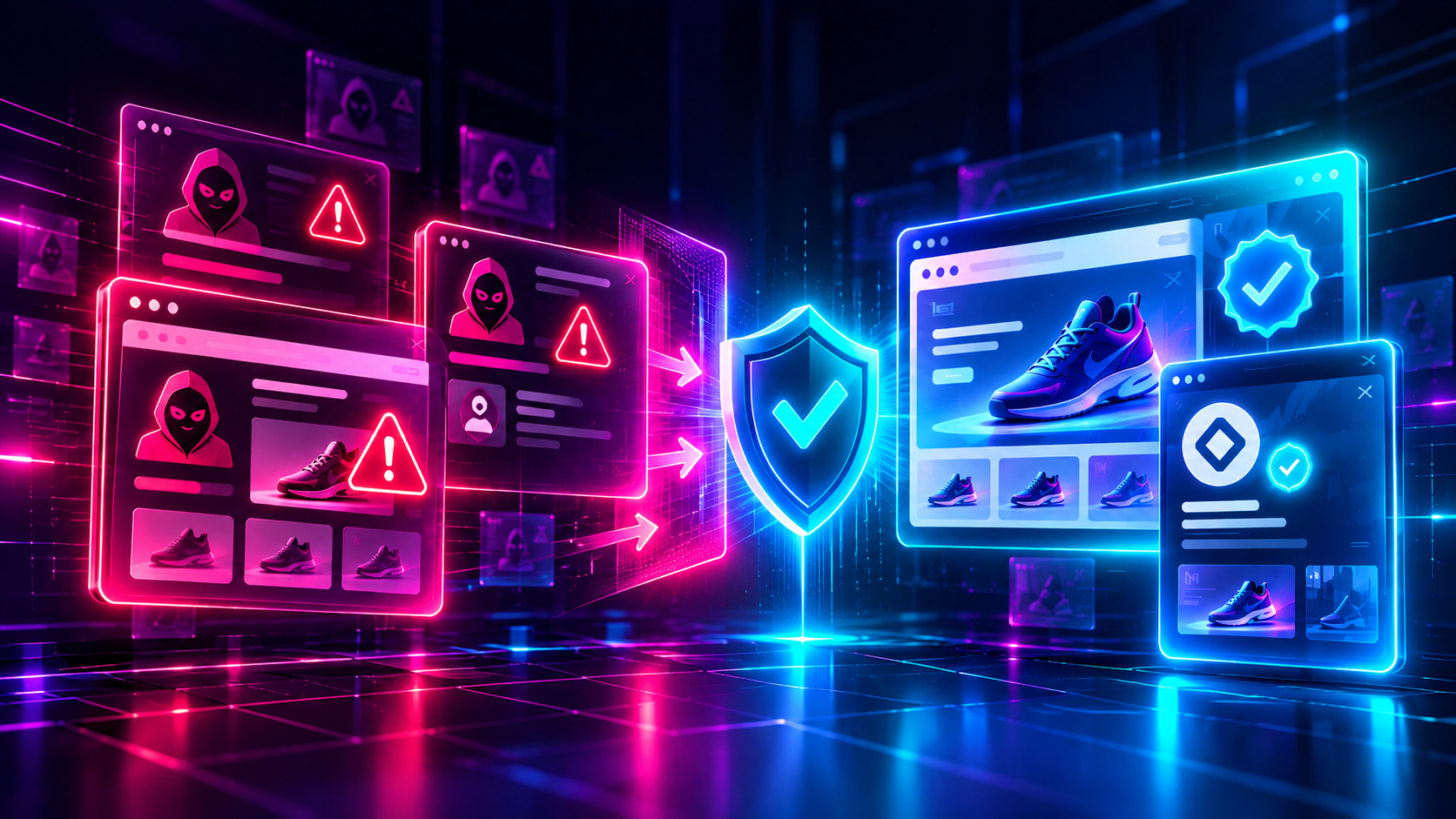
BrandShield helps organizations detect, investigate, prioritize, and remove phishing threats operating outside their corporate environment. Its approach combines AI-powered monitoring with human validation and expert-led enforcement across websites, domains, social media, paid ads, mobile apps, and other external channels.
The objective is not simply to add another security dashboard.
Instead, BrandShield focuses on finding the external infrastructure criminals use to impersonate trusted organizations.
Once BrandShield identifies a threat, its technology can help connect related domains, websites, profiles, and other assets into broader campaigns.
Human experts then help validate threats and move confirmed abuse toward enforcement.
This approach matters because attackers increasingly operate across channels.
A fake website may connect to a paid ad. The same campaign may use a social account. Meanwhile, another related domain may already be waiting to replace the first one.
Therefore, effective phishing protection needs to understand the campaign rather than only the individual URL.
Phishing Protection in 2026 Requires a Wider View
Internal cybersecurity controls remain essential.
However, attackers have learned that they do not always need to breach your network.
Sometimes it is easier to copy your brand and attack the people who trust it.
That is why phishing protection needs to extend beyond email, endpoints, and firewalls.
Organizations need visibility into fake websites, malicious domains, social accounts, fraudulent ads, rogue apps, and other external threats.
They also need to understand how those assets connect.
Most importantly, they need a process for removing confirmed threats before more people become victims.
The shift is simple:
Protect the network, but protect the trust surrounding the organization too.
Because when attackers impersonate your company, the infrastructure may belong to them.
But the reputation they are exploiting belongs to you.
See how BrandShield detects and removes phishing threats beyond the corporate perimeter. Request a BrandShield demo.
FAQ: Phishing Protection Beyond the Firewall
What Is Phishing Protection?
Phishing protection includes the tools and processes used to detect, prevent, investigate, and remove phishing attacks. Modern protection should cover email and internal systems as well as external threats such as fake websites, malicious domains, fraudulent social profiles, paid advertisements, and brand impersonation.
Why Aren’t Email Filters Enough for Phishing Protection?
Email filters only control messages that pass through the email environment they protect. Attackers can also reach customers and employees through websites, search results, social media, ads, messaging apps, and other external channels. Therefore, organizations need visibility beyond the inbox.
How Does AI Help With Phishing Protection?
AI can help analyze large volumes of domains, websites, images, text, and other threat signals much faster than manual review alone. It can also help identify patterns and relationships between assets, allowing security teams to prioritize active threats and investigate wider phishing campaigns.
Why Is Brand Impersonation a Phishing Risk?
Brand impersonation makes phishing more believable by borrowing the identity and reputation of a trusted organization. Attackers may copy logos, websites, executives, customer-support profiles, or other brand elements to convince victims that a fraudulent interaction is genuine.
How Can Companies Remove External Phishing Sites?
Companies first need to identify and validate the malicious site, collect evidence, determine the relevant host, registrar, platform, or provider, and pursue the appropriate enforcement process. Continuous monitoring and expert-led takedown workflows can help reduce the time between detection and removal.