Skip to content




Search interest in “AI scams” has surged in 2026, rising far faster than several established scam-related searches in a five-year Google Trends comparison. The trend does not prove AI scams are now the most common form of fraud, but it shows that AI has become a major part of how people understand and search for online scams.
For years, phishing scams, investment scams, crypto scams, and tech support scams have been familiar parts of the online fraud landscape. Now another search term is rapidly separating itself from the group: AI scams.
BrandShield reviewed Google Trends data for the United States over the past five years, comparing searches for “AI scams,” “phishing scams,” “investment scam,” “crypto scams,” and “tech support scams.” The data shows a clear shift. While interest in several scam categories has risen, searches for AI scams accelerated sharply during 2025 and 2026 and reached the highest peaks in this comparison.
That does not mean AI has created one completely new category of fraud. In many cases, the opposite is true. AI is making existing scams faster to build, easier to personalize, and more convincing.
Key Takeaways
- Search interest in AI scams has risen sharply in the United States during 2025 and 2026.
- Google Trends measures relative search interest, not the total number of scams or absolute search volume.
- AI scams often overlap with phishing, impersonation, investment fraud, fake shopping sites, and tech support scams.
- Generative AI can help scammers create convincing text, images, websites, voices, and other content faster.
- Scam campaigns increasingly operate across several channels, including websites, social media, paid ads, domains, and messaging platforms.
- Brands need to monitor the wider digital environment rather than relying only on security controls around their own websites and networks.
What Does Google Trends Tell Us About AI Scams?
Google Trends shows that US search interest in “AI scams” has risen dramatically and reached much higher peaks than the other scam terms included in BrandShield’s comparison.
The analysis compared five search terms over the past five years:
- AI scams
- Phishing scams
- Investment scam
- Crypto scams
- Tech support scams
For much of the five-year period, interest in AI scams was relatively low. However, that changed during 2025. The term began rising more quickly and then recorded several major spikes during 2026.
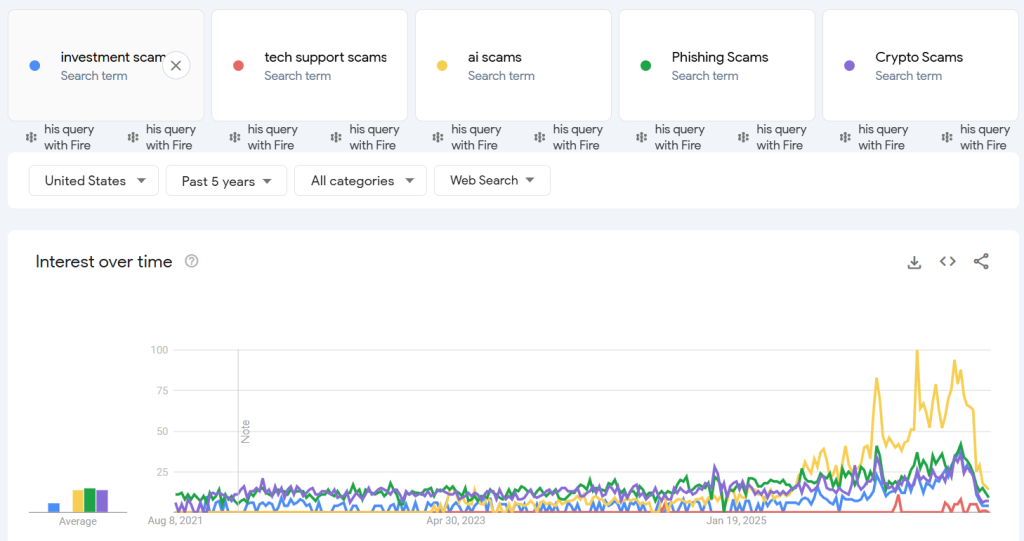
Phishing scams, investment scams, and crypto scams also show periods of stronger interest. However, none displays the same recent acceleration as AI scams in this specific comparison.
It is important to interpret the chart correctly. According to Google’s official explanation of Trends data, search results are normalized by time and location and then scaled from 0 to 100. A value of 100 represents peak relative interest within the comparison. It does not represent 100 searches or provide an absolute search-volume figure.
Therefore, this data cannot tell us that AI scams now cause more losses than phishing or investment fraud. Instead, it shows that public interest in the concept of AI-enabled scams is rising rapidly.
Why Are People Searching for AI Scams?
People are searching for AI scams because artificial intelligence is becoming visible across many forms of fraud that previously looked unrelated.
A few years ago, a phishing email, fake investment platform, fraudulent support call, and impersonating social profile might have been viewed as separate scam types.
Today, AI can sit behind all of them.
For example, scammers can use generative AI to improve writing, produce images, create convincing profiles, generate website content, translate scams into other languages, or imitate a person’s voice.
The FBI has specifically warned that criminals use generative AI to increase the scale and believability of financial fraud. The agency notes that AI can reduce the time and effort required to create deceptive content. Read the FBI’s guidance on generative AI and financial fraud.
More recently, the FBI documented scams that used AI-generated videos alongside spoofed websites to impersonate FBI personnel. In that campaign, AI content helped make the fraudulent experience appear more credible. See the FBI’s July 2026 warning about AI-assisted impersonation scams.
As a result, “AI scams” is becoming an umbrella term for something much broader than one fraud technique.
Are AI Scams Replacing Phishing Scams?
No. AI scams are better understood as an evolution of phishing, impersonation, investment fraud, fake shopping sites, and other existing scams.
The underlying goals have not changed much. Scammers still want to steal money, credentials, personal information, or account access.
What is changing is how quickly and convincingly they can build the experience around the scam.
Consider phishing. A traditional phishing campaign may have relied on a poorly written email and a simple copied login page. Today, AI can help improve the writing, localize the message, create variations, and help build more polished digital assets.
The same pattern applies elsewhere:
- Phishing scams: AI can support more polished emails, fake login pages, localized copy, and cloned websites.
- Impersonation scams: AI-generated images, voices, videos, and profiles can make impersonators more convincing.
- Investment scams: Fraudsters can create synthetic experts, fake promotional content, and professional-looking investment websites.
- Tech support scams: Fake support pages, chat experiences, and scripts can look more legitimate.
- Shopping scams: AI-generated stores, product descriptions, fake reviews, and promotional content can support fraudulent sellers.
- Executive impersonation: AI-generated voice or video can add credibility to a fraudulent request.
Therefore, the rise of AI scams does not mean phishing is disappearing. Instead, AI increasingly acts as an additional layer that can improve many established scam techniques.
BrandShield has already examined this shift in The Future of AI-Powered Brand Protection, including how automation is changing both attack and detection methods.
Why Did Interest in AI Scams Accelerate in 2025 and 2026?
The rise in search interest coincides with AI tools becoming easier for ordinary users to access and capable of producing more realistic digital content.
There is no single event that explains every Google Trends spike. However, several changes help explain why consumers are paying more attention to AI-enabled fraud.
AI-generated content looks more professional
One traditional warning sign of fraud was poor quality. Scam emails often contained obvious grammar mistakes. Fake websites looked unfinished. Profile images could appear unnatural.
However, those clues are becoming less reliable.
Generative AI can create polished writing and visual content with very little effort. Therefore, a scam no longer needs to look amateurish.
Voice and video impersonation are more accessible
AI also extends beyond text.
For example, the FBI has documented malicious campaigns involving AI-generated voice messages that impersonated senior US officials. The FBI’s warning describes AI-generated voice messages used in impersonation campaigns.
This changes how people verify identity. Hearing a familiar voice or seeing a realistic video can no longer serve as proof on its own.
AI can accelerate website creation
AI-assisted development tools can also reduce the technical skill needed to create websites and landing pages.
For legitimate companies, that means faster development. However, scammers can benefit from the same lower barrier.
A fraudulent support page, investment site, fake store, or phishing landing page can now be produced and modified faster than before.
Scams can be localized more easily
Language used to create friction for international scam campaigns.
Now AI can quickly translate and rewrite content for different regions. As a result, the same scam concept can be adapted to different languages and audiences with less manual work.
How Big Is the Broader Online Scam Problem?
Official US fraud data shows that impersonation and online scams already cause billions of dollars in reported losses, even without separating out an “AI scam” category.
The Federal Trade Commission reported that consumers lost more than $3.5 billion to imposter scams in 2025. Imposter scams represented nearly one in three fraud reports submitted to the agency that year.
Business impersonation alone accounted for nearly $1 billion in reported losses. See the FTC’s 2026 imposter scam data.
Meanwhile, the FTC reported that nearly 30% of people who said they lost money to a scam in 2025 said the scam began on social media. Those reported losses reached $2.1 billion. Read the FTC’s analysis of social media scam losses.
These figures should not be labeled AI-scam losses. The FTC categories cover much broader forms of fraud.
However, they show the size of the fraud environment into which increasingly accessible AI technology is being introduced.
Why Do AI Scams Matter for Brands?
AI scams matter for brands because attackers often borrow a company’s identity, reputation, executives, products, and digital assets to make fraud believable.
A customer may believe they are interacting with an official company website, advertisement, support representative, social profile, or executive.
However, the entire interaction may exist outside the company’s infrastructure.
This creates a difficult security gap.
A company’s firewall cannot block a fake website hosted elsewhere. Email security cannot remove a fraudulent paid advertisement. Endpoint protection cannot automatically stop a fake social profile from contacting customers.
That is why AI-enabled scams increasingly overlap with digital risk protection and online brand protection.
The attacker is not always trying to breach the company first. Instead, they may attack the trust surrounding the company.
What Does an AI Scam Campaign Look Like?
Modern scam campaigns often use several connected digital assets rather than relying on one fraudulent page or message.
For example, a campaign could look like this:
Fake paid ad → cloned brand website → fraudulent support page → payment request
Another might use:
Fake executive profile → direct message → AI-generated voice call → fraudulent investment platform
Or:
Counterfeit listing → social advertisement → fake store → fraudulent checkout
This matters because each element may appear unrelated when teams investigate it separately.
A security team might find the domain. Marketing may notice the ad. Customer support may receive a complaint about the fake account. Legal may find trademark misuse.
In reality, all four signals may belong to one campaign.
BrandShield developed its AI.ClusterX threat clustering technology around this problem. Instead of viewing every threat as an isolated event, clustering can help identify shared patterns and connected infrastructure across larger abuse networks.
How Can Brands Protect Customers From AI Scams?
Brands can reduce exposure to AI scams by monitoring the external channels where impersonation appears, connecting related threats, and acting quickly against high-risk fraud.
A practical program should include several layers.
1. Monitor lookalike domains and websites
Watch for domains that imitate the company’s name, products, support services, or login pages.
In addition, analyze the content on those sites. A domain becomes much more concerning when it also copies logos, website design, login forms, or payment flows.
2. Monitor paid advertisements
Paid ads can place a fraudulent site directly in front of someone already searching for the brand.
Therefore, companies should monitor both search and social advertising for unauthorized use of their names, logos, products, and landing pages.
BrandShield’s Paid Ad Protection monitors malicious ads across search engines and social media.
3. Detect social impersonation
Fake accounts may pose as the company, an employee, customer support representative, executive, or other trusted person.
Brands should monitor both identity and behavior. For example, an account directing users toward an unfamiliar external website may require fast investigation.
4. Monitor AI-driven discovery channels
Consumers increasingly use AI platforms to research companies and decide what to buy.
That creates another potential route between customers and malicious sources.
BrandShield discusses this emerging problem in AI Shopping: How to Stop Counterfeits and Fake Sellers.
5. Connect related threats
Do not assume every domain, ad, profile, or listing belongs to a different actor.
Instead, look for shared images, language, links, infrastructure, seller information, or other patterns.
This can reveal that a seemingly small incident is part of a wider campaign.
6. Prioritize active customer harm
Not every brand misuse case creates the same risk.
For example, a live phishing page collecting credentials should usually receive more urgent attention than an inactive page displaying an old logo.
Therefore, teams should prioritize based on threat severity, reach, customer exposure, and active fraudulent behavior.
7. Make legitimate channels easy to verify
Customers should know how to identify official websites, social accounts, support contacts, apps, and sellers.
Clear verification reduces the opportunity for scammers to fill gaps in the customer journey.
AI Scams FAQ
What are AI scams?
AI scams are fraud schemes that use artificial intelligence to create, improve, automate, or scale deceptive content and interactions. They can include phishing, impersonation, fake investment schemes, fraudulent websites, voice cloning, fake ads, and other existing scam types.
Are AI scams increasing in 2026?
Google Trends shows a sharp increase in US search interest for “AI scams” during 2025 and 2026. However, search interest does not measure actual scam volume. Official fraud agencies also continue to report high levels of impersonation, investment, phishing, and social media fraud.
How does AI make scams more convincing?
AI can help scammers create polished text, images, websites, voices, videos, and localized content more quickly. As a result, some of the spelling mistakes, poor design, and other warning signs traditionally associated with scams may be less obvious.
Are AI scams different from phishing scams?
They often overlap. AI can be used to improve a phishing campaign, create a fake website, imitate a trusted person, or produce content that makes an existing fraud method appear more credible.
How can brands detect AI-enabled scams?
Brands should monitor websites, domains, paid ads, social media, apps, marketplaces, and other external channels for impersonation and abuse. They should also connect related assets and prioritize threats that actively target customers.
The Bigger Shift Behind the AI Scam Search Surge
The rise of “AI scams” as a search term tells us something important about the changing fraud landscape.
AI has not replaced phishing, investment scams, tech support fraud, fake shopping sites, or impersonation.
Instead, it is increasingly becoming part of the infrastructure behind them.
That changes the economics of fraud. Scammers can create more content, test more variations, operate across more channels, and make deceptive experiences look more professional.
It also changes what brands need to protect.
Customers no longer interact with a company only through its official website. They encounter brands through search engines, social platforms, advertisements, marketplaces, AI assistants, mobile apps, and third-party websites.
Scammers operate in those same environments.
Therefore, the answer is not simply to tell customers to “be more careful.” Brands also need visibility into how their identity is being used outside the systems they control.
The Google Trends spike around AI scams is an early signal of that change. The more important story is what sits underneath it: AI is making the boundaries between scam categories harder to see.
For brands, that means phishing, impersonation, fake ads, scam websites, and other digital threats should increasingly be investigated as connected activity rather than isolated incidents.
To see how BrandShield detects, prioritizes, and responds to external digital threats across websites, domains, social media, paid ads, marketplaces, mobile apps, and AI platforms, talk to the BrandShield team.