Skip to content


Selling an unwanted item online should be straightforward. Upload a photograph, set a price, and wait for a buyer. Yet for some marketplace users, the first message they receive is not from a buyer at all. It is from a scammer pretending to be the platform.
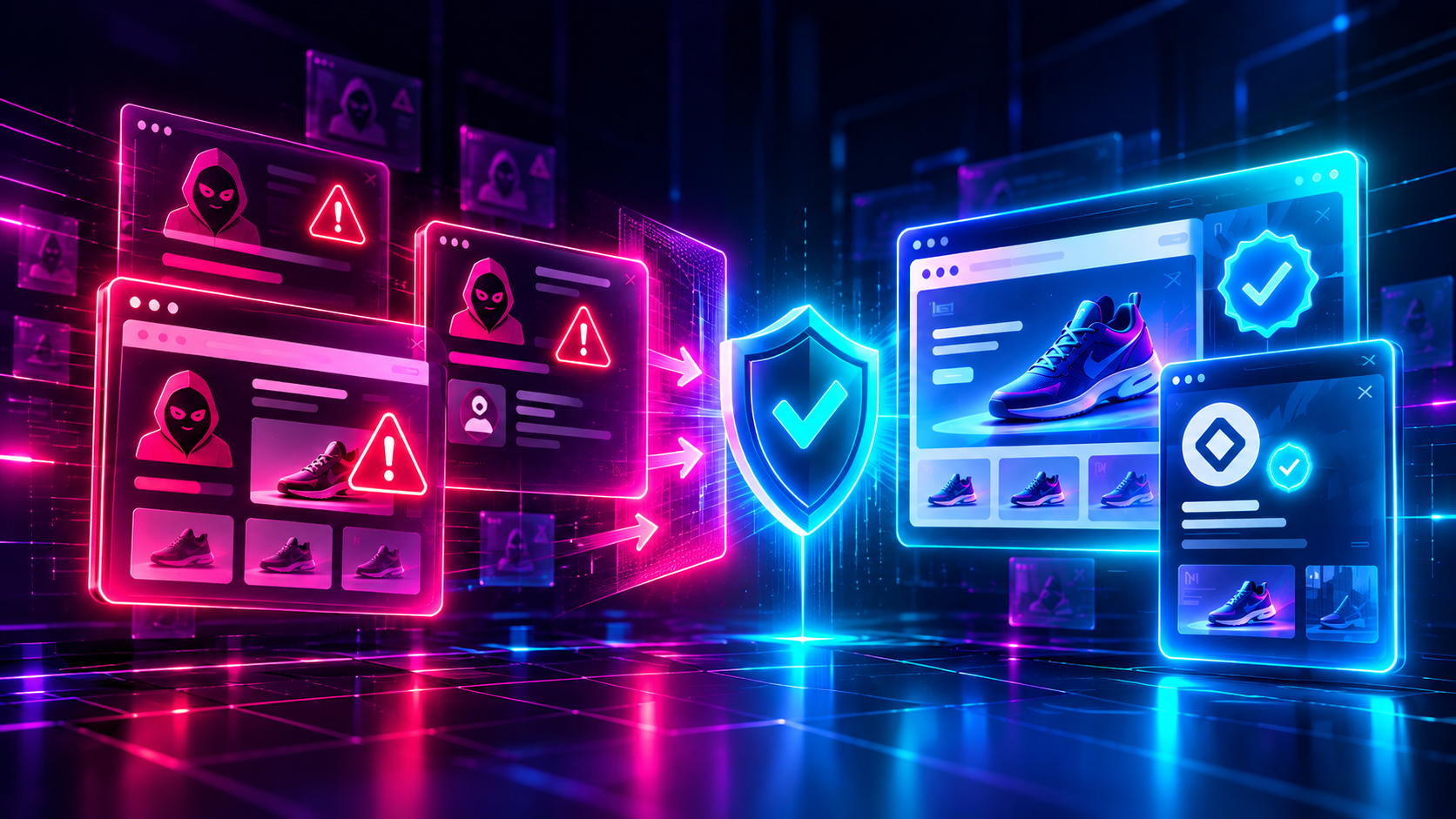
Online marketplace scams are fraudulent schemes that exploit the trust, payment systems, seller workflows, or brand identity of platforms such as Poshmark, Vinted, Amazon, eBay, Walmart Marketplace, Temu, and AliExpress.
They often start with a routine-looking request: verify your account, confirm a sale, scan a QR code, update your payment information, or contact support. The goal is to move you outside the marketplace’s normal process and collect credentials, payment details, personal information, or money.
The scale of online fraud makes these scams more than a user-awareness problem. According to the FBI’s 2025 Internet Crime Report, phishing and spoofing generated 191,561 complaints in 2025 and $215.8 million in reported losses. Non-payment and non-delivery generated another 56,478 complaints and $503.4 million in reported losses.
Key Takeaways
- Online marketplace scams often imitate normal seller tasks such as account verification, payment confirmation, or shipping.
- Urgency, lookalike domains, QR codes, fake support accounts, and requests to leave the platform are common warning signs.
- New sellers are attractive targets because they may not yet know how legitimate marketplace workflows operate.
- The scam infrastructure often sits outside the marketplace itself, on separate domains, websites, social accounts, and messaging channels.
- Brands and marketplaces need to monitor the wider campaign, not only remove the first fraudulent post or account they find.
How Online Marketplace Scams Target New Sellers
New sellers are especially useful targets because legitimate marketplaces sometimes do require identity checks, payment setup, or account verification. Scammers exploit that uncertainty.
A recent firsthand report on Reddit illustrates the pattern. A new Poshmark seller said they were tagged in a post styled as a notice from “Poshmark administration” shortly after uploading their first item. The notice told them they had 12 hours to complete mandatory verification through a website using the domain poshmarkyc.com or their account would be suspended.
The seller said they entered their email address, home address, and debit card details before realizing the website was fraudulent. You can read the original Poshmark scam report on Reddit. This is a firsthand user account, not an independently verified investigation.
The example is particularly convincing because legitimate seller verification does exist. Poshmark’s official Seller Verification Policy states that the platform may request identity documents or proof of address as part of its Know Your Customer process.
That overlap between a real process and a fake request is exactly what makes marketplace verification scams effective.
What Is a Marketplace Verification Scam?
A marketplace verification scam is a phishing attack in which criminals impersonate a marketplace’s support, payment, or safety team and direct users to a fraudulent verification process.
The attacker may ask for a password, debit card, bank information, government ID, address, or verification code. In other cases, the victim may be told they need to complete verification before receiving payment for a supposed sale.
The strongest scams mimic a genuine workflow. For example, the Poshmark case used several techniques at once:
- It appeared connected to the marketplace. The seller was tagged in a post rather than receiving an obvious spam email.
- It created urgency. The message used a 12-hour deadline and threatened account suspension.
- It targeted a new seller. The wording specifically referred to people who had just started selling.
- It used a lookalike domain. The fraudulent domain combined the Poshmark name with “KYC,” an industry term for Know Your Customer.
- It imitated customer support. A support-style interface made the fraudulent site feel more legitimate.
For a first-time seller, none of those steps necessarily looks impossible. That is the point.
Other Online Marketplace Scams Buyers and Sellers Face
Fake verification notices are only one version of online marketplace scams. Fraudsters also use fake sale confirmations, payment-release requests, counterfeit shipping notices, QR codes, fake customer support accounts, and external checkout pages.
The common pattern is the same: use the marketplace’s credibility, then move the user into a process the marketplace does not control.
Fake Sale and Payment Confirmations
A seller may receive a message claiming an item has sold even though no transaction appears in the official app. The message then directs the seller to enter payment details before they can supposedly receive their earnings.
Always confirm a sale inside the official marketplace account before responding to an email, message, or link.
QR Code Scams
QR codes can hide the destination of a link and make a fraudulent payment or verification page feel like part of the platform’s normal checkout flow.
A Vinted seller described this exact pattern in October 2026. Shortly after creating a first listing, the seller received a message saying the item had sold and was instructed to scan a QR code to verify the account and receive payment.
The seller reported entering debit card details, a home address, and an image of a driver’s license before the bank blocked an attempted $200 transaction. The original Vinted report is available on Reddit. Again, this is a firsthand user report rather than an independently verified investigation.
Vinted’s own phishing guidance specifically warns about fake messages, malicious websites, external payment requests, and QR code attachments. Vinted advises users to keep transactions inside the platform and avoid suspicious external links.
Fake Customer Support
Fraudsters may also pose as marketplace support agents through fake profiles, comments, social accounts, emails, or websites.
A message may claim that your account has a problem, that a buyer’s payment is waiting, or that your seller profile will be restricted unless you act immediately.
When support contacts you unexpectedly, verify the message through the platform’s official app or help center before providing any information.
Moving the Transaction Off Platform
Requests to continue through WhatsApp, Telegram, email, text message, or an external checkout page should raise concern.
Moving outside the official transaction flow can remove marketplace protections and makes it easier for the attacker to introduce fake payment pages, phishing links, or fraudulent shipping instructions.
Why These Scams Are a Business Problem, Not Just a User Problem
When criminals impersonate a marketplace or retail brand, the legitimate company can suffer even if its own systems were never compromised.
Users see the marketplace name, logo, seller identity, or product image throughout the scam. So when something goes wrong, the victim’s negative experience can become associated with the legitimate brand.
For retail and ecommerce teams, the impact can include:
- Loss of seller trust. A bad first experience can make a new seller reluctant to continue using the platform.
- Higher support load. Real support teams must handle fraud reports, account recovery, disputed transactions, and confused users.
- Reputation damage. Reviews, social posts, and forum discussions may describe the fraud using the legitimate marketplace’s name.
- Account takeover. Stolen credentials can give attackers access to legitimate seller or buyer accounts.
- Brand abuse beyond the platform. Lookalike domains, fraudulent ads, fake social profiles, and counterfeit stores can extend the campaign into other channels.
The mistake many teams make is treating each fake message or account as a separate incident.
Often, the marketplace message is only the entry point.
The fake verification site may sit on a lookalike domain. Social accounts may distribute the link. Paid ads may send more users to the same infrastructure. If you remove only one account, the rest of the campaign can remain online.
What Are the Warning Signs of Online Marketplace Scams?
The clearest warning signs are unexpected urgency, requests to leave the platform, suspicious domains, payment or verification requests that do not appear in the official app, and demands for sensitive information.
Watch for:
- Messages claiming your account will be suspended within a few hours
- Requests to “verify” a sale that does not appear in your marketplace account
- Domains containing the marketplace name plus words such as verify, secure, KYC, payment, or support
- QR codes sent through marketplace messages, email, or social media
- Requests for debit card, bank, password, or identity information through an unfamiliar site
- Buyers asking you to move the conversation to email, WhatsApp, Telegram, or text
- Payment confirmations that do not appear inside the official marketplace
- Messages from unofficial support profiles
If something looks wrong, do not use the link in the message. Open the official app yourself or type the marketplace’s known web address directly into your browser.
What Should You Do If You Receive a Suspicious Marketplace Message?
If you receive an unexpected payment, verification, shipping, or account-security message, verify it independently before taking action.
- Do not click the link or scan the QR code.
- Open the official marketplace app. Check whether the sale, payment, warning, or verification request appears there.
- Check the domain carefully. Look for misspellings, extra words, or unusual domain endings.
- Do not submit payment or identity information through an unsolicited link.
- Contact official support. Use the help center or support option inside the marketplace.
- If you already entered financial information, contact your bank immediately.
- Change compromised passwords and enable multi-factor authentication where available.
- Preserve the evidence. Save screenshots, URLs, usernames, emails, QR codes, and timestamps before reporting the scam.
The FBI also advises fraud victims to retain original records, transaction information, websites, email addresses, and other information used by criminals when filing an IC3 complaint.
How Retail and eCommerce Brands Can Get Ahead of Marketplace Impersonation
User awareness helps, but it should not be the only defense. A first-time seller should not need to understand KYC, domain registration, phishing infrastructure, or payment fraud to avoid being scammed.
For brands and marketplaces, the better strategy is to identify and disrupt the infrastructure behind the scam before it reaches more users.
Monitor Lookalike Domains
Attackers often combine brand names with terms such as support, secure, verify, login, KYC, payment, or account.
Continuous domain protection can help identify registrations that may be used for phishing, fake support, or marketplace impersonation.
Monitor Marketplace and Social Accounts Together
A scam can begin in a marketplace message and continue through social media, a fake website, or a messaging app.
Your monitoring should therefore connect fake seller profiles, impersonation accounts, suspicious listings, and the external sites they promote rather than viewing each platform in isolation.
Look for Seller and Campaign Networks
For retail brands, individual counterfeit or scam listings may be linked to larger seller networks. Shared product images, usernames, domains, contact details, descriptions, and payment indicators can expose connections between accounts.
BrandShield’s Marketplace Brand Protection helps brands monitor marketplaces for counterfeits, unauthorized sellers, trademark abuse, and related seller activity.
Connect Impersonation Across Channels
A marketplace scam can also be part of a broader brand impersonation campaign.
For example, the attacker may use a fake marketplace profile to distribute a link to a cloned website hosted on a lookalike domain. That same domain may appear in social posts or phishing messages.
This is why brand impersonation protection should focus on the relationships between assets, not only the first fake account that appears.
Prioritize Enforcement, Not Detection Volume
Finding thousands of suspicious listings or accounts does not help if your team cannot determine which ones create the greatest risk.
Prioritize the assets that are actively collecting credentials, taking payments, impersonating customer support, selling counterfeits, or directing users into a wider scam network.
Then preserve evidence and use the appropriate enforcement route with marketplaces, registrars, hosts, social platforms, and other service providers.
How BrandShield Helps Protect Marketplace Trust
BrandShield combines AI-powered monitoring, threat analysis, and expert-led enforcement to identify marketplace abuse and related external threats.
Instead of treating a fake listing, domain, social profile, and phishing page as unrelated findings, BrandShield can help connect them into a wider campaign so your team can prioritize the underlying operation.
BrandShield’s broader Online Brand Protection platform covers marketplaces alongside websites, domains, social media, paid ads, mobile apps, and other external channels.
The value of this approach is visibility. Marketplace abuse does not always stay on the marketplace.
As BrandShield customer Michele Michaeli, VP Marketing, put it: “Now we are always in control of our relevant digital environment.”
Online Marketplace Scams FAQ
What are the most common online marketplace scams?
Common scams include fake sale notifications, fraudulent payment requests, fake seller verification, QR code phishing, counterfeit shipping notices, fake support accounts, account takeover, and requests to complete a transaction outside the marketplace.
How can I tell if a marketplace verification request is real?
Open the official marketplace app or website independently and check your account there. Do not rely on a link, QR code, email, or message that claims verification is required.
Why do scammers target new marketplace sellers?
New sellers may not yet know what the marketplace’s normal payment, verification, and shipping processes look like. That makes a fake request easier to present as a routine step in completing a first sale.
Should a seller leave the marketplace to receive payment?
Usually, no. Major marketplaces provide their own payment and transaction workflows. A request to visit an unfamiliar site, communicate through another app, or enter financial information externally should be verified before you continue.
How can brands protect themselves from marketplace impersonation?
Brands should monitor marketplaces, domains, social platforms, websites, and paid ads for misuse of their identity. They should also connect related accounts and infrastructure, preserve evidence, prioritize high-risk activity, and enforce against confirmed scams.
Final Thoughts
For buyers and sellers, the safest response to an unexpected verification or payment request is simple: check it independently inside the official marketplace before doing anything else.
However, warning users cannot be the only line of defense.
For marketplaces and retail brands, online marketplace scams create a wider brand-protection problem. Criminals can exploit a trusted name without compromising the company’s systems, then move victims onto domains, websites, social accounts, QR codes, and payment pages that sit outside the marketplace’s direct control.
That is why the strongest response combines in-platform safeguards with external monitoring, investigation, clustering, and takedown.
Scammers are not only targeting transactions. They are targeting the trust that makes those transactions possible.