Skip to content




Updated: September 2026
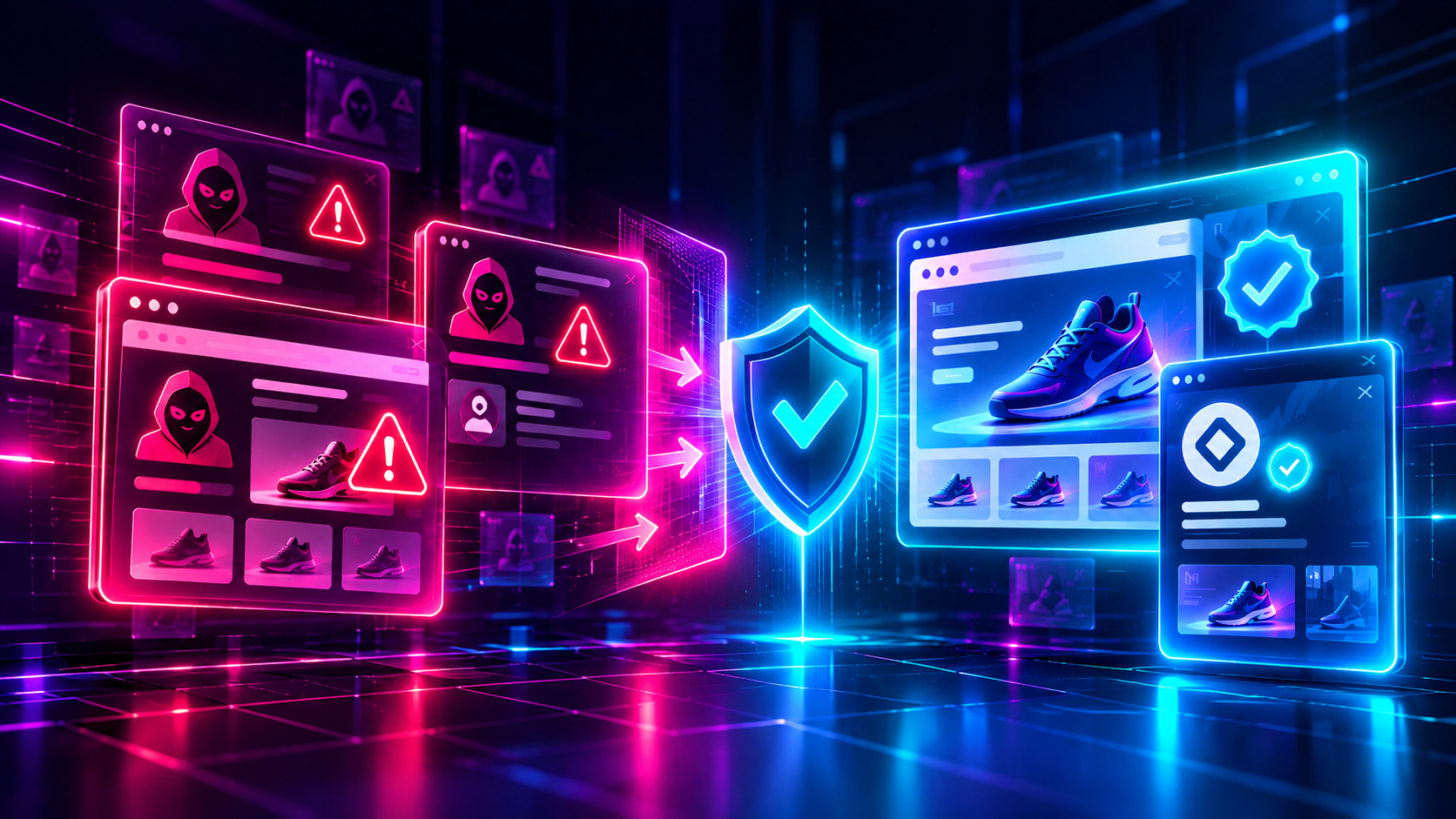
Online brand protection for businesses helps companies detect and stop counterfeits, phishing, impersonation, fake websites, and other misuse of their identity online. It protects customers, revenue, intellectual property, and trust across the digital channels where brands operate.
Online brand protection for businesses is the ongoing process of finding, assessing, and removing digital threats that misuse a company’s brand, products, identity, or intellectual property.
Online brand abuse now appears across almost every digital channel. For example, counterfeit networks, AI-powered phishing scams, fake domains, impersonation accounts, scam ads, and rogue websites can all target the same company.
Meanwhile, generative AI has made some forms of online abuse faster and easier to create. Scammers can produce polished websites, convincing messages, product images, and fake profiles with less time and skill.
Therefore, online brand protection is no longer only a legal or trademark issue. It has become an important part of protecting customers, revenue, and digital trust.
Key Takeaways
- Online brand protection for businesses covers counterfeits, phishing, impersonation, fake domains, rogue apps, fraudulent ads, and other forms of digital abuse.
- Threats can appear across websites, marketplaces, social media, search engines, app stores, ads, domains, and other digital channels.
- AI can help attackers create more convincing scam content and launch campaigns faster.
- Detection alone is not enough. Companies also need to validate threats, prioritize them, and enforce takedowns.
- Effective brand protection combines automated monitoring with human review and ongoing takedown activity.
What Is Online Brand Protection?
Online brand protection detects, investigates, and stops unauthorized use of a company’s brand, identity, products, and intellectual property across digital channels.
For example, a company may need to detect counterfeit products, fake websites, social media impersonators, phishing domains, copied content, rogue mobile apps, or fraudulent advertisements.
However, brand protection goes beyond trademark enforcement. It also protects the trust that customers place in a company’s name and digital presence.
The purpose is simple. Bad actors should not be able to use your name, products, content, or reputation to deceive customers.
Therefore, online brand protection for businesses can include monitoring and enforcement across:
- Websites and domains
- Online marketplaces
- Social media platforms
- Paid search and social advertisements
- Mobile app stores
- Search engines
- AI platforms
- Messaging services
- The surface, deep, and dark web
In addition, companies should protect trademarks, copyrighted material, product images, logos, and other intellectual property. The World Intellectual Property Organization explains the main forms of intellectual property protection.
Why Online Brand Protection for Businesses Matters in 2026
Online brand protection for businesses matters because digital abuse can damage customer trust, divert sales, expose consumers to fraud, and weaken a company’s reputation. The FTC reported $3.5 billion in impersonation scam losses in 2025, making imposter scams the most commonly reported form of fraud. The OECD and EUIPO estimate global trade in counterfeit goods at $467 billion, or 2.3% of global imports.
Large companies are obvious targets because criminals can benefit from their brand recognition. However, smaller companies can also face impersonation, fake advertisements, phishing, and counterfeit activity.
In addition, attackers do not need to breach a company’s network to cause harm.
For example, a scammer can register a lookalike domain and create a fake website. Another attacker can open an impersonating social account. Meanwhile, a counterfeit seller can copy official product images and sell fake goods on a marketplace.
When this happens, the threat exists outside the company’s own systems. Therefore, traditional internal security controls may not detect it.
When businesses experience online brand abuse, the damage can extend beyond a single incident.
Reputation Damage and Loss of Trust
Online brand abuse can damage trust when customers mistake fraudulent content for an official brand experience.
For example, a customer may encounter a fake domain, counterfeit product, or fraudulent profile using a company’s name.
Even though the company did not create the threat, the customer may still connect the poor experience with the real brand. Therefore, detecting impersonation early can help reduce reputational harm.
Revenue Loss and Market Diversion
Counterfeits, fake stores, and scam advertisements can divert customers away from legitimate sales channels.
For example, a fraudulent seller may use official product images to attract buyers. A fake website may also appear in search results or paid advertisements.
As a result, customers can reach the fraudulent version of a brand before they find the real company.
Consumer Safety Risks
Online brand abuse can expose customers to financial fraud, unsafe products, malware, and identity theft.
For example, counterfeit goods may create physical risks. Fake websites may collect payment details. Meanwhile, impersonating support accounts may ask customers to share personal information.
Therefore, brand protection also plays a role in customer safety.
Legal and Compliance Exposure
Unauthorized use of trademarks, logos, copyrighted content, and other intellectual property can create legal and enforcement challenges.
Therefore, companies should document misuse and build clear processes for reporting confirmed violations.
What Should an Online Brand Protection Solution Include?
An effective online brand protection solution should combine broad digital monitoring, risk prioritization, investigation, human review, and scalable enforcement across the channels where customers interact with brands.
For companies building online brand protection for businesses, the goal is not simply to generate more alerts. Instead, teams need to identify which threats create the most risk and act on them quickly.
Comprehensive Monitoring Across Digital Channels
The platform should monitor a wide range of online environments for misuse of brand identities and assets.
For example, look for a solution that monitors websites, domains, marketplaces, social media, mobile apps, advertisements, and other external digital environments.
Its AI-powered technology should help identify suspicious profiles, counterfeit listings, cloned websites, fraudulent domains, and other forms of online brand abuse.
Learn more about BrandShield’s Online Brand Protection platform.
Actionable Insights and Prioritization
Effective brand protection should help teams understand which findings require action first.
For example, a live phishing website collecting customer credentials can create more immediate risk than an inactive domain.
The solution should help teams review threats based on factors such as severity, business impact, and customer exposure.
Enforcement and Takedowns
Detection only creates value when companies can act on confirmed threats.
Look for a solution that supports enforcement workflows across platforms, registrars, marketplaces, hosting providers, and other relevant services.
Automated workflows can also reduce manual work. However, final removal times depend on the platform, provider, violation type, and available evidence.
Expert Analyst Support
Human review adds context to automated detection and helps teams focus on genuine threats.
Look for a solution with analysts who can validate findings, review evidence, identify abuse patterns, and support enforcement actions.
As a result, technology and human expertise can work together to reduce noise and improve accuracy.
What Are the Main Online Threats to Brands in 2026?
Major online threats include phishing, impersonation, cybersquatting, counterfeit products, fake advertisements, copied content, rogue apps, and other forms of digital fraud.
However, these threats often overlap. Therefore, online brand protection for businesses should look for connections between different channels and assets.
Phishing Attacks and Social Engineering
Phishing uses deceptive messages, websites, or digital experiences to trick people into sharing information, credentials, or money.
For example, attackers may create fake login pages or customer-service messages that copy a trusted brand.
In addition, AI can help attackers improve writing, translate messages, and produce more polished content.
Therefore, companies should monitor suspicious domains and websites that imitate their identity.
Learn more about online phishing protection.
Cybersquatting and Domain Impersonation
Cybersquatting involves registering domain names that copy or closely resemble another organization’s brand or trademark.
For example, attackers may change one letter, add a word, or use a different domain extension.
These domains can then host phishing pages, fake shops, malware, or other fraudulent content.
For information about domain-name disputes, see the ICANN Uniform Domain Name Dispute Resolution Policy.
Counterfeit Products Across Marketplaces
Counterfeit sellers use marketplaces, websites, and social platforms to offer unauthorized copies of genuine products.
For example, sellers may copy product images, descriptions, logos, and packaging from the legitimate brand.
In addition, the same seller may operate across several platforms. Therefore, removing one listing may not address the full network.
BrandShield’s Marketplace Brand Protection helps brands detect and enforce against marketplace abuse.
Fake Reviews and Manipulated Ratings
Fake reviews can distort how customers judge products, sellers, and online stores.
For example, fraudulent sellers may use positive reviews to make counterfeit listings appear more trustworthy.
Meanwhile, misleading reviews can make it harder for customers to identify legitimate sellers.
Copyright and Content Infringement
Scammers often copy official images, videos, product descriptions, and marketing materials to make fraudulent content look genuine.
For example, stolen product photography can help a fake store appear more professional.
Therefore, copied brand content can also act as a useful signal when teams investigate possible impersonation.
Negative SEO and Search Manipulation
Attackers may use spam websites, copied content, malicious domains, or other tactics to capture search traffic intended for a legitimate brand.
For example, a fake site may target branded search terms and then direct visitors toward fraudulent products or services.
As a result, brands should monitor how their identity appears in search as part of a broader protection program.
How a Marketplace Counterfeit Campaign Works
Marketplace counterfeit campaigns typically use multiple seller accounts, copied product images, reused descriptions, fake reviews, and overlapping storefronts to make fraudulent listings look legitimate.
According to the OECD and EUIPO, clothing, footwear, and leather goods accounted for 62% of seized counterfeit goods, showing how heavily consumer brands are targeted.
Counterfeit operators can spread the same products across several marketplaces and seller identities, often reusing images, packaging, pricing patterns, and account details. These shared signals can reveal that individual listings belong to the same wider operation.
Effective enforcement therefore focuses on both the individual listings and the relationships between sellers, storefronts, and assets. Connecting those signals can help teams identify repeat activity and target the broader counterfeit campaign.
How a Social Media Impersonation Campaign Works
Social media impersonation campaigns use fake profiles, pages, ads, and direct messages to pose as companies, executives, employees, or customer-support representatives.
Impersonating accounts often build credibility by copying logos, profile images, brand language, and public information before directing users to fraudulent websites, payment requests, or phishing pages.
Detection and response require teams to identify the fake account, preserve evidence, review connected domains or profiles, and submit enforcement requests when appropriate. Monitoring related assets can also reveal whether the account is part of a larger impersonation campaign.
How Can You Build Online Brand Protection for Businesses?
A strong online brand protection program starts with mapping brand assets, monitoring the right channels, prioritizing high-risk threats, and creating a clear enforcement process.
Companies should treat online brand protection for businesses as an ongoing process rather than a one-time project.
1. Conduct a Complete Brand Protection Audit
Start by identifying the assets, people, products, and digital channels that attackers are most likely to misuse.
For example, map trademarks, product names, domains, social profiles, executives, apps, websites, and marketplace presence.
In addition, document common variations of your brand name. This creates a clearer view of your external attack surface.
2. Establish Proactive Protection Measures
Companies should secure important trademarks, domains, and official social accounts before attackers can claim similar assets.
For example, organizations can register important domain variations and reserve official usernames where appropriate.
Therefore, proactive protection can reduce some opportunities for impersonation.
3. Implement Continuous Monitoring and Automation
Continuous monitoring helps companies detect new threats as they appear across fast-moving digital channels.
Manual searches can help with individual cases. However, they become difficult to scale across many websites, domains, social networks, marketplaces, advertisements, and apps.
Therefore, automation is an important part of online brand protection for businesses with a large digital footprint.
4. Combine Machine Intelligence With Human Expertise
AI can identify suspicious patterns at scale, while human analysts provide context, validation, and enforcement expertise.
For example, automated detection can surface possible threats. Analysts can then decide whether the activity represents genuine abuse and what action is appropriate.
BrandShield combines AI-powered detection with expert human analysis. As a result, teams can focus more attention on relevant threats and reduce noise from low-priority findings.
5. Execute Fast Remediation and Adversary Disruption
Companies should move from detection to action quickly when a threat presents a clear risk to customers or the business.
For example, enforcement may include removing counterfeit listings, reporting fake profiles, targeting malicious websites, or acting against fraudulent domains.
However, removal should not always end the investigation. Teams should also monitor for the same actor or campaign reappearing elsewhere.
6. Connect Related Threats
Individual threats often form part of a larger digital abuse campaign.
For example, the same operator may control a fake website, several social profiles, fraudulent advertisements, and marketplace listings.
Therefore, teams should look for shared domains, images, seller details, infrastructure, content, and other signals.
BrandShield’s AI.ClusterX threat clustering helps identify links between related online threats.
How Do You Choose the Right Brand Protection Solution?
A modern brand protection solution should combine broad digital coverage, automated detection, risk prioritization, human expertise, and scalable enforcement.
When evaluating online brand protection for businesses, companies should consider:
- Which websites, marketplaces, social networks, domains, apps, and advertising channels the platform monitors
- How the platform detects phishing, impersonation, counterfeits, fake ads, and other abuse
- How findings are prioritized by severity and business impact
- Whether analysts review and validate threats
- How enforcement and takedown workflows operate
- Whether the platform can connect related threats across channels
- How teams track takedowns, recurrence, and enforcement results
However, the number of alerts should not be the main measure of success.
Instead, companies should focus on whether the solution can identify the threats that matter most and help teams act on them.
Online Brand Protection for Businesses FAQ
What Is Online Brand Protection for Businesses?
Online brand protection for businesses is the process of detecting, investigating, and stopping unauthorized use of a company’s brand, products, identity, and intellectual property across digital channels.
For example, it can cover counterfeiting, phishing, impersonation, fake websites, fraudulent ads, rogue apps, and marketplace abuse. The OECD and EUIPO estimate global trade in counterfeit goods at $467 billion, or 2.3% of global imports.
Why Is Online Brand Protection Important in 2026?
Online brand protection matters because customers now interact with companies across many digital environments that the company does not directly control.
In addition, AI can help attackers create more convincing content and launch scams faster. Therefore, brands need wider visibility into external digital threats. The FTC reported $3.5 billion in imposter scam losses in 2025.
What Threats Can Online Brand Protection Detect?
Online brand protection can identify threats such as counterfeit listings, phishing domains, impersonation profiles, fake websites, rogue apps, scam ads, and other unauthorized brand use.
However, the exact coverage depends on the solution and the channels a company needs to monitor. WIPO handled a record 6,282 domain-name dispute cases in 2025, highlighting the continued scale of cybersquatting and fraudulent domain activity.
How Does BrandShield Combine AI and Human Expertise?
BrandShield uses AI-powered technology to identify suspicious activity at scale, while analysts help validate, prioritize, and investigate relevant threats.
As a result, companies can combine automation with human context when deciding which threats require action.
Which Digital Channels Can BrandShield Monitor?
BrandShield monitors external digital environments including websites, domains, marketplaces, social media, advertisements, mobile apps, and other online channels.
Therefore, companies can monitor brand abuse beyond their official websites and internal systems.
Can BrandShield Remove Infringing Content?
BrandShield supports enforcement workflows designed to remove confirmed infringements from relevant websites, platforms, marketplaces, hosts, registrars, and social networks.
However, final removal times vary depending on the platform, type of violation, evidence, and third-party response.
Is Online Brand Protection Only for Large Enterprises?
No. Online brand abuse can affect companies of different sizes whenever customers, products, executives, or digital assets can be impersonated or misused.
Therefore, the scope of protection should match the company’s risk, digital footprint, and business model. The FTC reported $1.9 billion in fraud losses tied to social media in 2024, showing how widely consumers can be exposed to online scams across digital channels.
How Quickly Can Online Threats Be Removed?
Detection can happen quickly, but takedown time varies by platform, provider, threat type, and available evidence.
Therefore, companies should track both detection speed and enforcement outcomes rather than assume every threat can be removed within the same timeframe. WIPO administered a record 6,282 domain-name dispute cases in 2025, illustrating the scale of formal domain enforcement processes that can affect resolution timelines.
Conclusion
Online brand protection for businesses has become an important part of protecting customers, revenue, intellectual property, and trust in 2026.
The challenge is no longer limited to counterfeit products or trademark misuse.
For example, companies now face phishing sites, fake domains, impersonating social accounts, scam advertisements, rogue apps, copied content, and abuse across marketplaces.
Meanwhile, AI can help attackers create and adapt some of these threats faster.
Therefore, companies need visibility beyond their own websites and security perimeter.
Effective online brand protection for businesses combines continuous monitoring, automated detection, threat prioritization, human analysis, and enforcement.
In addition, teams should look for connections between individual threats. One fraudulent domain or profile may be part of a much larger campaign.
BrandShield helps companies detect, investigate, prioritize, and remove online threats across external digital environments.
As a result, brands can focus on the risks that matter most while protecting customers and maintaining control over their digital identity.
To learn how BrandShield can strengthen your online brand protection for businesses strategy, talk to the BrandShield team.