Skip to content


Your team opens the dashboard Monday morning and finds a fake store, several counterfeit listings, a lookalike domain, and a social account impersonating your brand. Finding those threats is only the first step. You still need to know which ones matter most and how quickly they can be removed.
We’re proud to announce that BrandShield was ranked the number one Leader in G2’s Fall 2025 Brand Protection category. The recognition reflects verified customer feedback on results, usability, implementation, support, and customer relationships.
Brand protection is the process of detecting, investigating, prioritizing, and stopping unauthorized or harmful use of a company’s brand, trademarks, products, executives, and digital assets.
For organizations facing phishing, counterfeits, impersonation, trademark abuse, and other online threats, detection alone is not enough. You also need clear priorities, reliable enforcement, useful reporting, and a team that can help you act.
Key Takeaways
- BrandShield ranked as the number one Leader in G2’s Fall 2025 Brand Protection category.
- G2 also recognized BrandShield across results, usability, implementation, relationship, enterprise, mid-market, and small-business reports.
- G2 rankings use verified customer feedback, so actual customer experience contributes directly to the results.
- Customers highlighted areas including implementation, threat detection, enforcement, reporting, scalability, and support.
- For buyers, the more useful question is not simply who ranks highest, but whether a platform can help your team move from detection to action.
Why Did G2 Rank BrandShield #1 in Brand Protection?
G2 ranked BrandShield as a Leader based on verified customer reviews and its position within the Brand Protection category. Customers highlighted results, ease of use, implementation, support, reporting, and the overall experience of protecting their brands online.
G2 gives software buyers another way to evaluate vendors through feedback from people who use the products. Therefore, these rankings can provide a useful signal when you compare online brand protection solutions.
BrandShield’s current G2 seller profile shows a 4.7 out of 5 rating from 122 reviews and lists BrandShield as number one in one category. These figures should be checked again before publication because G2 ratings and review counts can change.
In Fall 2025, BrandShield earned recognition across several G2 reports. The results covered organizations of different sizes, from small businesses to global enterprises.
BrandShield was recognized in these G2 categories:
- Overall Grid® Report for Brand Protection
- Results Index for Brand Protection
- Usability Index for Brand Protection
- Enterprise Grid® Report for Brand Protection
- Mid-Market Relationship Index for Brand Protection
- Implementation Index for Brand Protection
- Small-Business Grid® Report for Brand Protection
- Relationship Index for Brand Protection
- Mid-Market Grid® Report for Brand Protection
So the recognition goes beyond one badge. It reflects customer feedback across several parts of the product and customer experience.
What Does Effective Brand Protection Look Like?
Effective brand protection finds online threats, identifies which ones pose the greatest risk, connects related activity, and gives your team a clear path to enforcement.
The mistake we see most often is treating detection volume as the main measure of success. A dashboard full of alerts does not help if your team cannot tell which threats matter or what to do next.
Online abuse can appear across websites, domains, social media, marketplaces, paid ads, mobile apps, and other channels. Therefore, broad visibility matters when the same operator uses several platforms at once.
For example, one fake store may be promoted by several social accounts and paid ads. The same operator may also control lookalike domains or counterfeit marketplace listings.
If you investigate each asset separately, you can miss the wider campaign.
BrandShield uses AI-powered technology to detect and analyze these threats. Its approach helps teams identify patterns and focus on the risks that matter most. You can read more in our guide to AI-powered brand protection.
What Does This Look Like in a Real Brand Protection Program?
Ferrara provides a useful example of what happens when detection and enforcement work together.
In a published BrandShield case study, Ferrara faced fraudulent listings across social media and online marketplaces. Over a three-month period, BrandShield reported 1,319 fraudulent listings and removed 1,221 of them, resulting in a 92.7% takedown success rate, according to the Ferrara success story.
The same case study reported takedown success rates of 85% for websites, 94% for social media, and 96% for online marketplaces. Those results came from continuous monitoring combined with investigation and enforcement.
“BrandShield’s staggering ~90% takedown success rate of our fraudulent online listings alone, speaks for itself.”
This is the point buyers should focus on. Detection matters, but the real outcome is whether your team can turn a finding into a verified case and then into an enforcement result.
Customer Feedback Behind the G2 Recognition
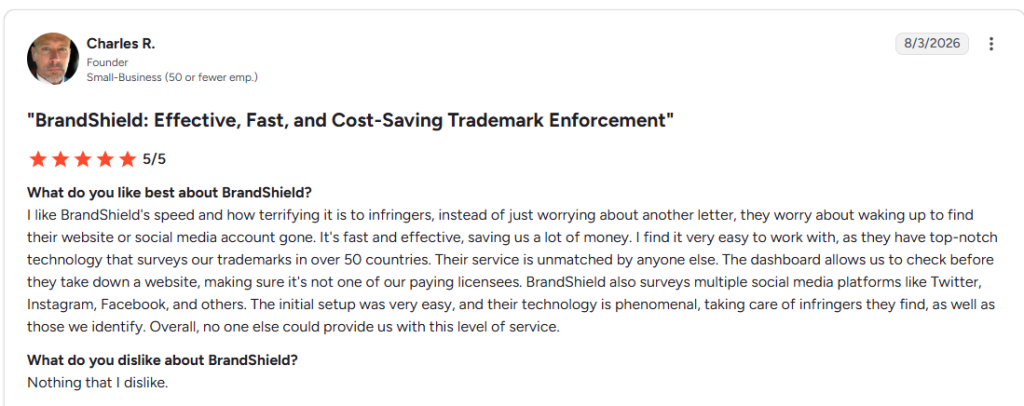
The G2 recognition reflects recurring themes in BrandShield customer feedback, including ease of use, fast results, reporting, scalability, and hands-on support.
Those factors matter because online brand abuse rarely stops after one takedown. Your team needs a workflow that can continue as new sellers, domains, accounts, and sites appear.
An Intuitive Platform Backed by Support
Customers noted that BrandShield makes it easier to monitor potential infringements and move cases forward. In addition, reviews highlighted proactive account management and practical guidance from the BrandShield team.
Fast Results From the Start
Some customers reported seeing enforcement results early in the relationship. Moreover, they highlighted how BrandShield adapts monitoring to their industry and specific risk profile.
Clear and Actionable Reporting
Customers also pointed to reporting as an important benefit. Clear reports help your team explain threats, enforcement activity, and outcomes to internal stakeholders.
Proactive Threat Detection
Rather than waiting only for customer complaints or manual reports, BrandShield monitors external channels for new threats. As a result, your team can identify issues earlier and decide which ones require action.
Fast Implementation
Customers described a smooth onboarding process and quick access to relevant threat data. Therefore, teams can begin reviewing findings without a long implementation cycle.
Protection Built for Global Scale
Large organizations may need to monitor threats across countries, platforms, languages, and business units. BrandShield is designed to organize that activity so your team can focus on the cases that require attention.
How Does BrandShield Help Protect Brands Online?
BrandShield combines AI-powered monitoring, threat analysis, risk prioritization, human validation, and expert-led enforcement to protect companies against online abuse.
The platform monitors external channels and helps organizations understand which findings require the fastest response.
Threats can include:
- Counterfeit products
- Fake online stores
- Phishing websites
- Lookalike domains
- Trademark infringement
- Fake social media profiles
- Executive impersonation
- Unauthorized sellers
- Malicious advertisements
- Rogue mobile apps
However, detection alone does not solve the problem.
Your team also needs to understand whether several findings belong to the same operator or campaign. BrandShield’s threat clustering helps connect related sellers, domains, profiles, listings, advertisements, and other assets.
As a result, organizations can move beyond one-by-one enforcement and investigate wider networks of abuse.
What Should You Look for in a Brand Protection Provider?
G2 recognition is useful, but it should not be your only buying criterion.
If you are evaluating a provider, I would start with five questions:
- Can it find the threats you actually face? Your marketplace, domain, social, ad, app, and website exposure should drive the evaluation.
- Can it prioritize risk? Your team should not have to treat every alert as equally important.
- Can it connect related assets? Several listings, sites, profiles, and ads may belong to the same operator.
- What happens after detection? Look closely at validation, investigation, evidence, escalation, and enforcement.
- Can you measure outcomes? Reporting should show what was found, what was removed, how quickly action happened, and where repeat abuse remains.
The provider with the most alerts is not necessarily the strongest one. What matters is whether the system helps your team find the right threats and act on them efficiently.
Why Customer Relationships Matter
Online brand protection requires ongoing analysis and action, so the relationship between your organization and its provider can directly affect how quickly cases move.
Technology can surface threats. However, experienced teams still play an important role when cases require investigation, prioritization, evidence, escalation, or enforcement.
That is why BrandShield’s recognition in G2’s Relationship Index matters.
Threats also change quickly. Counterfeit sellers may switch marketplaces, while phishing operators can replace blocked domains with new ones.
Therefore, your provider needs to adapt as tactics change.
BrandShield combines its technology with experienced detection and enforcement teams. This model helps customers manage complex external threats without relying entirely on internal resources.
You can also learn more about the changing threat environment in our analysis of online brand infringement trends.
Why the G2 Recognition Matters to BrandShield
BrandShield’s G2 Fall 2025 rankings reflect feedback from organizations that use the platform to protect their brands online.
For us, that matters because the customer experience extends beyond the technology itself. Detection quality, enforcement, reporting, support, and implementation all affect how well your program works day to day.
As Itai Galmor, Chief Revenue Officer at BrandShield, said:
“We’re incredibly proud to be ranked the number one leader in Brand Protection and to be recognized across so many key categories.”
He added:
“These rankings are more than just a reflection of our product innovation and enforcement capabilities. They represent the trust our customers place in us every day. As digital threats continue to evolve, our mission remains clear: to protect brands with speed, precision, and care.”
We thank every customer who took the time to share their experience. Their feedback helps us improve how we detect, analyze, prioritize, and stop threats targeting brands online.
FAQ: Brand Protection and BrandShield’s G2 Ranking
What is brand protection?
Brand protection is the process of detecting and stopping unauthorized or harmful use of a company’s brand, trademarks, products, executives, and digital assets. Online protection can cover websites, domains, marketplaces, social media, mobile apps, advertisements, and other digital channels.
Why was BrandShield ranked #1 for Brand Protection?
BrandShield ranked as the number one Leader in G2’s Fall 2025 Brand Protection category based on verified customer reviews and its position in G2’s evaluation. Customers highlighted areas including results, usability, implementation, support, and overall experience.
What online threats does BrandShield detect?
BrandShield detects threats such as counterfeit products, phishing sites, fake stores, impersonation, trademark abuse, rogue social accounts, malicious ads, rogue apps, and lookalike domains. The platform also helps teams connect related threats and prioritize higher-risk activity.
Who uses brand protection software?
Legal, intellectual property, security, fraud, ecommerce, and brand teams commonly use online protection software. Large organizations may involve several of these teams because external abuse can affect customers, revenue, reputation, cybersecurity, and intellectual property at the same time.
How can companies improve online brand protection?
Companies can improve online protection by monitoring external channels, identifying connected threats, prioritizing risk, and acting quickly against verified abuse. They should also track results so teams can understand where threats originate and which enforcement approaches work best.
Ready to see why customers rank BrandShield as a leader?