Skip to content


By Oren Todoros · Last updated: September 30, 2026
Picture this: it is Monday morning, and your customer-support team forwards a complaint about a fake store using your logo. A quick search finds the same brand name on a marketplace listing, a paid ad, and a lookalike domain. Your team now has to decide what is actually infringement, what creates the most risk, and what to remove first.
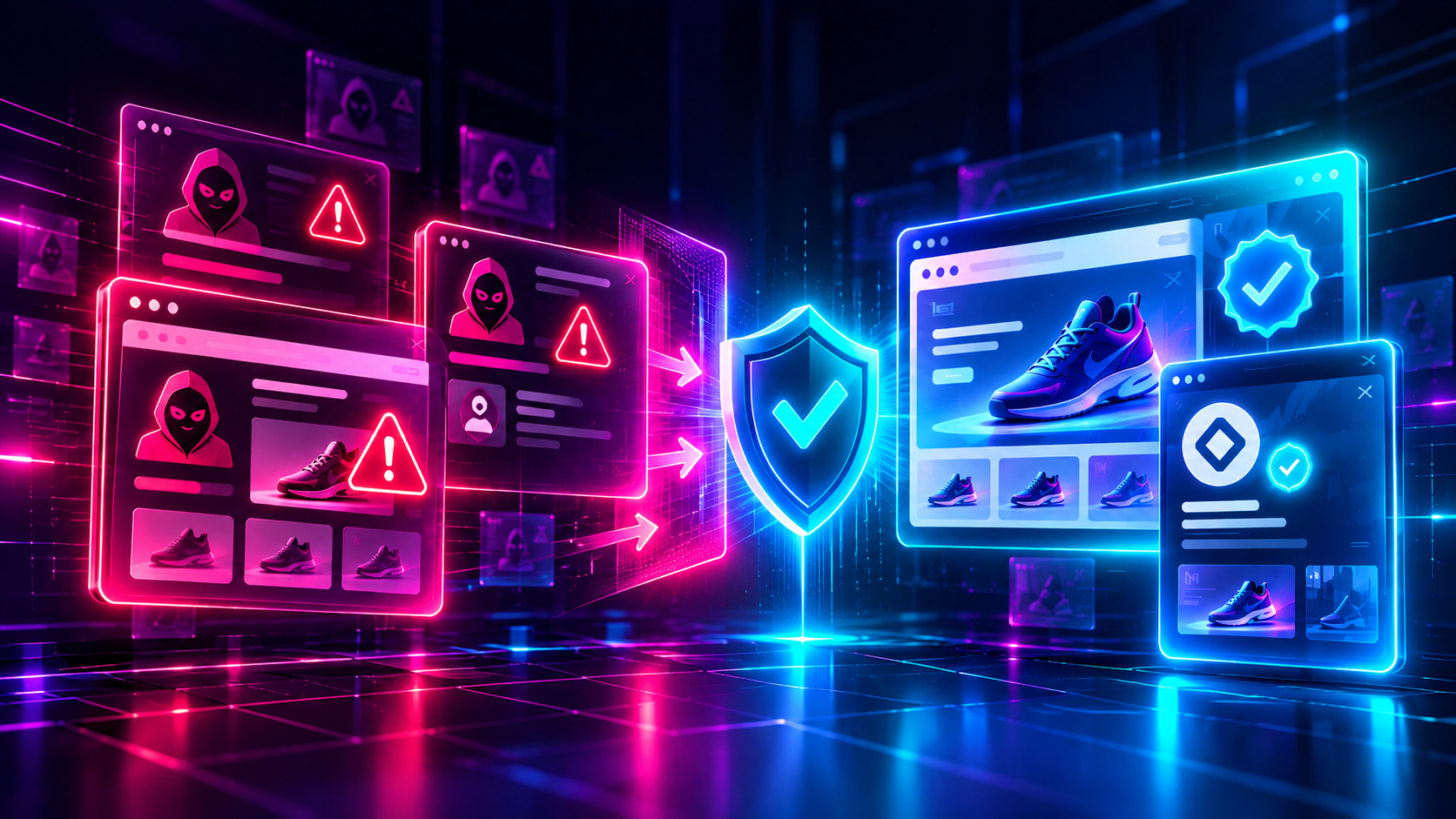
Trademark infringement is the unauthorized use of a protected mark in a way that is likely to confuse consumers about the source, sponsorship, or affiliation of goods or services. Online, it can appear in counterfeit listings, fake websites, social profiles, paid ads, mobile apps, and lookalike domains.
In 2026, trademark infringement rarely looks like a single copied logo. Bad actors can use your trademark to sell counterfeit goods, impersonate your company, create phishing pages, or divert customers through fraudulent ads.
The mistake we see most often is treating every use of a trademark as equally urgent. It is not. If you manage brand protection, your first job is to identify the activity that creates real customer, legal, or commercial risk.
If your business has a recognizable name, logo, product, or service, you have something others can misuse. Active online brand protection helps you find that misuse before it spreads across more channels.
Key Takeaways
- Trademark infringement generally involves unauthorized trademark use that is likely to confuse consumers about source, sponsorship, or affiliation.
- Online infringement can appear through counterfeit listings, fake websites, paid ads, social impersonation, mobile apps, and lookalike domains.
- Trademark registration strengthens your rights, but it does not show you where abuse is happening online.
- Your team should preserve URLs, screenshots, seller details, timestamps, and proof of rights before enforcement.
- Not every trademark use deserves the same response. Prioritize phishing, active fraud, counterfeit sales, and high customer exposure first.
- AI can help you find suspicious activity at scale, while human review helps decide whether enforcement is justified.
What Is Trademark Infringement?
Trademark infringement generally means using another party’s protected trademark without permission in a way that is likely to confuse consumers. The confusion may concern who made, sponsored, endorsed, or is affiliated with a product or service. However, the exact legal test depends on the jurisdiction and the facts.
The U.S. Patent and Trademark Office’s trademark infringement guidance explains the U.S. standard.
“Trademark infringement is the unauthorized use of a trademark or service mark on or in connection with goods and/or services.” — U.S. Patent and Trademark Office
Two marks also do not need to look identical for confusion to exist. According to the USPTO’s guidance on likelihood of confusion, marks can be similar in appearance, sound, meaning, or overall commercial impression.
The goods or services matter too. For example, similar marks used for closely related products may create more confusion than the same words used in unrelated industries.
The World Intellectual Property Organization’s IP enforcement guidance also identifies likelihood of confusion as a core issue in trademark enforcement.
For a practical enforcement guide, see BrandShield’s article on how to report a trademark violation.
What Is the Difference Between Trademark Infringement and Trademark Violation?
Trademark infringement usually refers to unauthorized trademark use that may cause consumer confusion, while trademark violation is often used more broadly for different forms of trademark misuse. People often use the terms interchangeably, but your enforcement options still depend on the specific rights and facts involved.
For example, you might find a copied logo on a counterfeit listing, a fake website using your company name, a deceptive paid ad, or a social account impersonating customer support.
Those cases can look very different. However, each may exploit the trust attached to the same trademark.
So do not start with the label alone. Start by asking what the user is likely to believe, what harm the activity creates, and what evidence you can prove.
What Are Common Examples of Trademark Infringement Online?
Online trademark infringement can appear anywhere someone uses your brand identity to sell, advertise, impersonate, or mislead. Your monitoring therefore needs to cover more than Google search results.
| Type of Abuse | What You May See | Why It Matters |
|---|---|---|
| Counterfeit listings | Your name or logo used to sell fake goods | Lost sales, customer complaints, safety risk |
| Fake websites | A cloned storefront or company page | Fraud, payment diversion, impersonation |
| Phishing pages | Your branding around a fake login form | Credential and payment theft |
| Fake social profiles | Accounts posing as your company or staff | Customer deception and scam outreach |
| Fraudulent paid ads | Ads using your mark to drive traffic elsewhere | Traffic diversion and fraud |
| Lookalike domains | Domains designed to resemble your official site | Phishing, fake stores, customer confusion |
One campaign can use several of these tactics together. A paid ad may use your logo, send customers to a lookalike domain, and then sell counterfeit products.
That is why we recommend looking for links between threats rather than treating every asset as a separate case.
For more examples, read BrandShield’s guide to online brand infringement.
How Big Is the Trademark and Counterfeit Problem in 2026?
Current enforcement data shows that trademark-related abuse remains widespread across domains and international commerce. Two figures help put the scale into perspective.
According to the World Intellectual Property Organization, trademark owners filed 6,282 domain-name cases in 2025. That was 1.8% more than in 2024 and the highest annual total in the service’s 25-year history.
Meanwhile, the OECD and EUIPO Mapping Global Trade in Fakes 2025 report estimated counterfeit trade at $467 billion in 2021, equal to about 2.3% of global imports.
Those figures measure different forms of abuse, so they should not be combined into one “trademark infringement” total. However, together they show why digital enforcement remains a serious issue for rights owners in 2026.
Why Does Trademark Infringement Hurt a Business?
Trademark infringement can affect your revenue, customer trust, reputation, and internal workload at the same time. A customer may never realize that the seller, site, ad, or social profile has no connection to your company.
Lost Revenue
Counterfeit sellers and fake websites can divert customers from your official sales channels.
For example, a shopper may search for your product and find an unauthorized listing first. If the customer buys there, your genuine product never gets the sale.
Damage to Customer Trust
Customers judge the experience by the brand name they see.
If someone receives a poor-quality counterfeit carrying your logo, they may blame you. So even when you had no role in the transaction, your reputation can still take the hit.
Customer Safety and Fraud
Some trademark abuse creates an immediate safety or security problem.
A fake bank login may steal credentials. Counterfeit medicine, electronics, cosmetics, or automotive parts can create physical risks.
So for many teams, trademark abuse sits across legal, security, fraud, and customer protection.
Operational Costs
Infringement also consumes time across your business.
Your legal team may review trademark rights. Security may investigate phishing. Marketing may find fraudulent ads. Customer support may handle complaints from people who thought they were dealing with you.
Finding serious abuse earlier can reduce that reactive workload.
A Real Example: How Pop-A-Lock Dealt With Online Brand Abuse
Pop-A-Lock provides a useful example of how trademark and brand abuse can move from isolated local issues into a much wider digital problem. The company had dealt with local misuse of its brand for years, but online activity expanded the number and type of threats it had to manage.
BrandShield’s published Pop-A-Lock case study describes counterfeit websites, deceptive search ads, and misleading search results that diverted customers and affected brand trust. As the volume grew, manual monitoring was no longer enough.
“When bad actors misuse our brand online, it doesn’t just hurt our bottom line.” — Robert Reynolds, Director of Operations, Pop-A-Lock
The lesson for your team is practical. Do not wait until you have dozens of unrelated complaints before creating a monitoring and enforcement process.
Once the same trademark appears across websites, ads, domains, and search results, you need visibility across the whole campaign rather than one URL at a time.
How Can You Protect Your Brand From Trademark Violations?
Protecting a trademark requires more than registration. You need legal rights, ongoing monitoring, good evidence, clear priorities, and the right enforcement route.
If we were building the process from scratch, we would start in this order:
- Protect the trademarks that matter most commercially.
- Monitor the channels where customers actually encounter your brand.
- Preserve evidence before contacting sellers or platforms.
- Prioritize threats that create active customer or revenue risk.
- Use the correct enforcement route for each platform and violation.
- Track whether the same seller, site, or campaign returns.
1. Register Your Trademarks in Important Markets
Trademark registration can strengthen your ability to act against unauthorized use. Focus on important names, logos, slogans, and product marks in the markets where you operate.
However, rights differ by country. So work with qualified legal counsel when deciding where and how to register.
The USPTO’s trademark basics provides current guidance for the United States.
2. Monitor for Trademark Violations
Continuous monitoring helps you find possible infringement before it reaches more customers or spreads to more channels. Check websites, marketplaces, social media, paid ads, mobile apps, and domains.
Manual searches remain useful for one-off investigations. However, they do not scale well if your team tracks many products, countries, sellers, and trademarks.
3. Monitor Logo and Image Misuse
Visual monitoring can find abuse that keyword searches miss. A seller may avoid writing your brand name while still using your logo, packaging, product photography, or design.
For example, a counterfeit listing may reuse an official product photo but change the written title.
So image recognition should complement text and keyword monitoring.
4. Monitor Paid Advertising
Paid ads can place trademark abuse directly in front of customers who are already searching for your brand. An advertiser may copy your name, logo, product image, or promotional message and send the user somewhere else.
A fake ad can even appear above your organic result. That means the fraudulent experience may reach the customer before your official website does.
BrandShield’s Paid Ad Scam Protection helps monitor search and social advertising for this type of abuse.
5. Take the Right Enforcement Action
Your enforcement route should match the violation, platform, rights, and evidence. Do not send the same generic complaint everywhere.
Depending on the case, you may need to:
- Submit trademark complaints to Amazon, eBay, or another marketplace.
- Report fake accounts to Facebook, Instagram, TikTok, or another social platform.
- Report fraudulent advertisements to Google or social ad networks.
- Contact a hosting provider about an abusive website.
- Contact a domain registrar when the domain itself is part of the abuse.
- Send a cease-and-desist notice.
- Use a formal domain-dispute process such as the UDRP when appropriate.
- Escalate serious or repeated cases to legal counsel.
Before you submit anything, save the URL, screenshots, timestamps, account information, seller details, advertisements, and evidence of your trademark rights.
6. Prioritize the Most Serious Threats
Not every trademark mention deserves the same amount of time. This is another area where teams often get stuck.
We would prioritize an active phishing page collecting credentials over an old page displaying a logo. Likewise, a seller moving large volumes of counterfeits should usually rank above a low-reach account with no active sales.
Consider:
- Is there active fraud?
- Are customers being exposed now?
- Is money changing hands?
- Are credentials or payment details being collected?
- How large is the audience or seller reach?
- Does the same actor control other assets?
- How strong is your evidence?
Risk-based prioritization helps your legal and brand teams spend time where it has the greatest impact.
7. Educate Internal Teams and Customers
Your employees and customers can become useful early-warning sources if they know what to report.
Marketing might spot a fake ad. Support may hear about an impersonating store. Security may identify phishing, while legal receives marketplace complaints.
Create one simple internal path for those reports. Customers should also be able to verify your official websites, sellers, social accounts, and support channels.
How Can AI Help Detect Trademark Infringement?
AI can help your team scan large volumes of websites, listings, images, advertisements, domains, and social content for possible trademark infringement. It can flag brand names, logos, copied images, similar domains, seller patterns, and other signals.
However, AI should not make the final legal judgment.
A model may find hundreds of listings that use similar product photography. Analysts still need to decide whether those findings show counterfeiting, authorized resale, commentary, comparison, or legitimate use.
AI can also help connect separate threats. Shared domains, images, seller details, accounts, or infrastructure may show that several findings belong to the same operation.
That is where AI becomes most useful. It helps you scale detection and prioritization, while people provide context and decide what action makes sense.
How Does BrandShield Help With Trademark Protection?
BrandShield combines AI-powered detection, risk prioritization, human validation, and enforcement workflows to help companies find and respond to trademark and brand abuse online.
Monitoring covers websites, marketplaces, social networks, paid ads, domains, and mobile apps.
BrandShield can identify trademark infringement, counterfeit products, logo misuse, impersonating accounts, fraudulent advertising, and other unauthorized use.
Our experience also shows why detection volume alone is a poor measure of success. A useful brand-protection program should tell your team which findings matter, which assets connect to each other, and where enforcement will have the greatest effect.
For example, BrandShield’s threat-clustering technology can help identify connections between domains, sellers, listings, profiles, ads, and other assets. That lets your team investigate a broader campaign instead of treating every finding as a separate event.
For counterfeit goods, BrandShield’s Online Counterfeit Protection combines automated detection with expert-led enforcement across marketplaces and other digital channels.
Trademark Infringement FAQ
What Qualifies as Trademark Infringement?
Trademark infringement generally involves unauthorized use of a protected mark in a way that is likely to confuse consumers about the source, sponsorship, or affiliation of goods or services. The exact legal standard varies by jurisdiction and case.
What Are Common Examples of Trademark Violations Online?
Common examples include counterfeit listings, copied logos, fake websites, social impersonation, deceptive advertisements, and lookalike domains. One scam can combine several forms of abuse at once.
How Can I Tell if Someone Is Infringing My Trademark?
Look for unauthorized use of your name, logo, product imagery, or other protected assets in a way that may confuse customers. Similarity alone does not always prove infringement, so consider the context, products, services, jurisdiction, and likely customer impression.
What Should I Do if I Find a Trademark Violation Online?
First, preserve the evidence. Save the URL, screenshots, seller or account details, timestamps, and any ads or payment information.
Then assess the risk and choose the correct enforcement route. That may involve a marketplace, social platform, ad network, registrar, host, or formal legal process.
Do I Need a Registered Trademark to Take Action?
Registration can provide important legal and enforcement benefits, but trademark rights vary by country. In the United States, some rights can arise through use, so consult qualified legal counsel when assessing a specific case.
Final Thoughts
Trademark infringement in 2026 is not limited to someone copying your logo. It can appear in counterfeit listings, cloned websites, social accounts, paid ads, mobile apps, and lookalike domains.
Registration gives you rights. It does not give you visibility.
Your team still needs to find the abuse, understand the risk, preserve the evidence, and choose the right enforcement route.
Most importantly, do not try to remove every trademark mention you find. Focus on activity that creates customer confusion, active fraud, commercial harm, or meaningful legal risk.
If you can combine legal rights with continuous monitoring, risk-based prioritization, and effective enforcement, you can protect far more than the trademark itself. You protect the trust attached to it.
To see how BrandShield can help detect trademark infringement, counterfeits, impersonation, and other forms of online brand abuse, talk to the BrandShield team.