Skip to content



A social account is using your logo. A paid ad offers your products at a steep discount, and dozens of positive comments underneath make the offer look legitimate. The problem is that the account, advertisement, and comments have nothing to do with your company.
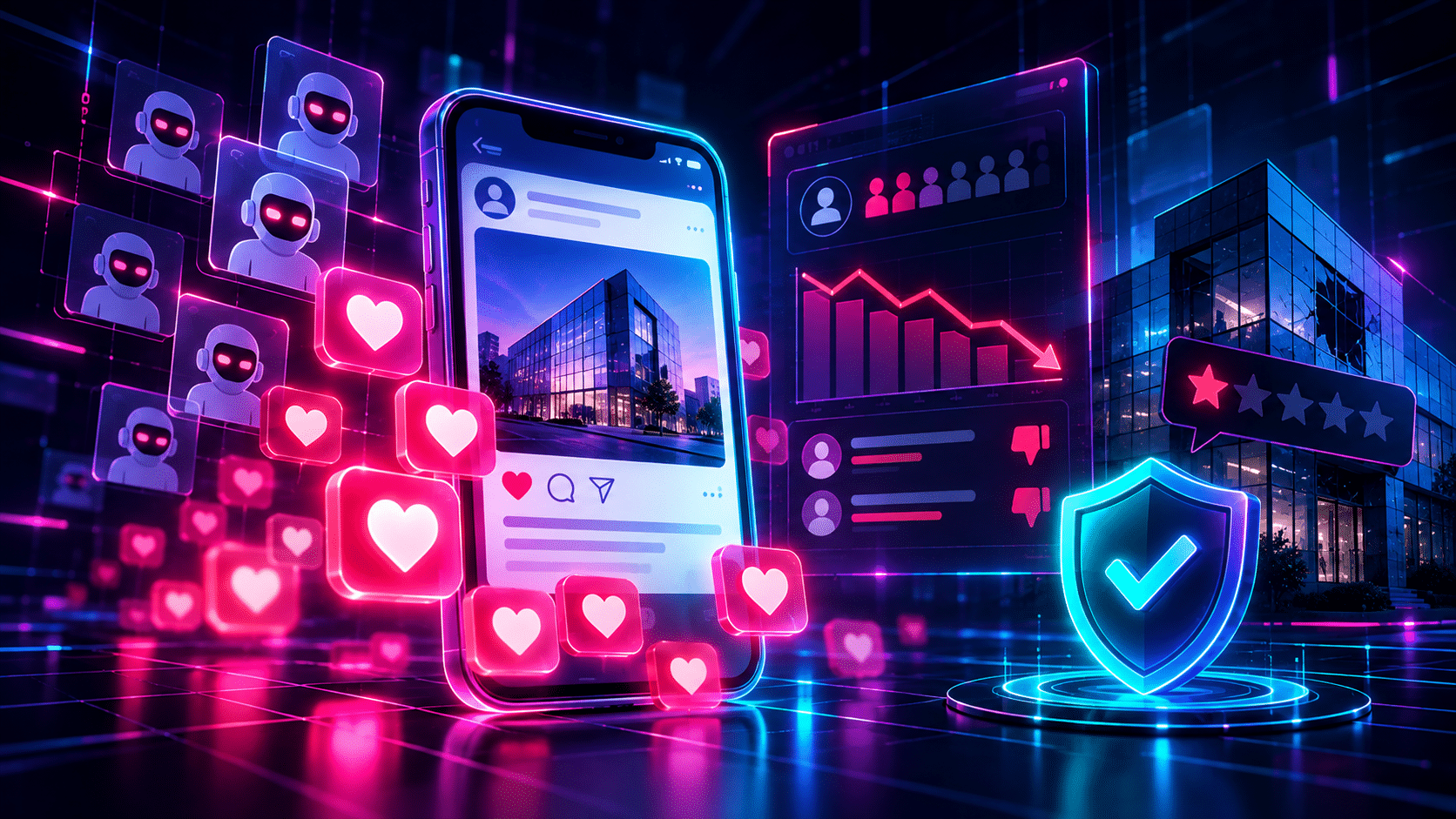
That is where fake engagement stops being a marketing annoyance and becomes a brand protection issue. Likes, reviews, followers, and comments can give fraudulent accounts and counterfeit offers the appearance of credibility they have not earned.
Social media fraud is the use of fake accounts, reviews, followers, ads, engagement, or impersonation to deceive users, create false credibility, or redirect consumers toward fraudulent products and websites.
For brand protection teams, the concern goes well beyond inflated engagement. Fake social proof can support counterfeit sellers, impersonation accounts, cloned stores, fraudulent advertisements, and wider scam campaigns across several digital channels.
Key Takeaways
- Fake likes, reviews, followers, and testimonials can create false credibility around fraudulent products and accounts.
- Social media fraud often connects to counterfeit listings, fake stores, lookalike domains, paid ads, and impersonation accounts.
- The FTC reported that consumers lost $2.1 billion to scams that started on social media in 2025.
- Shopping scams were the most frequently reported type of social media scam in 2025.
- Brand owners need to investigate both the visible social account and the wider network behind it.
What Is Social Media Fraud?
Social media fraud includes deceptive activity that uses social platforms, fake engagement, impersonation, advertisements, or false identities to influence or defraud users.
It can include fake likes, purchased followers, false reviews, fake testimonials, impersonation accounts, counterfeit product ads, and posts that redirect consumers toward fraudulent websites.
The problem has grown well beyond the fake “likes” discussed a decade ago. According to the Federal Trade Commission, consumers reported losing $2.1 billion to scams that started on social media in 2025, about eight times the amount reported in 2020.
The FTC also found that nearly 30% of people who reported losing money to a scam in 2025 said the scam started on social media.
Those figures help explain why social platforms have become an important part of the external attack surface for consumer-facing brands.
Where Did the Idea of “Fliking” Come From?
The tactic itself is not new.
In 2015 and 2016, Stuart Fuller of NetNames used the term “Fliking” to describe the practice of buying or soliciting fake likes, followers, tweets, and positive reviews to create artificial credibility online.
Fuller described the practice in a 2015 article about “Fliking”. He argued that counterfeiters and other deceptive sellers could use the same social signals as legitimate marketers to make their online presence appear more trustworthy.
At the time, examples included Facebook likes, Twitter followers, LinkedIn connections, and positive online reviews.
The term itself did not become mainstream. The behavior did.
In 2026, the same basic tactic appears in more forms:
- Fake followers inflate the apparent reach of an account.
- Fake reviews create false confidence in a seller or product.
- Fake comments make fraudulent ads appear popular.
- Impersonation accounts borrow the reputation of legitimate brands.
- Paid social ads direct consumers toward cloned stores or counterfeit sellers.
- Coordinated accounts amplify fraudulent offers across several platforms.
The technology has changed. The trust tactic has not.
Why Do Fake Likes and Reviews Matter?
Fake engagement matters because consumers often use social proof as a shortcut for trust.
A product with hundreds of positive comments may appear safer than one with none. A social account with thousands of followers can look established. A five-star review can reduce hesitation before a purchase.
Fraudsters understand that behavior and can use it to make a suspicious offer appear credible.
The FTC’s 2024 Consumer Reviews and Testimonials Rule prohibits several deceptive practices, including buying or selling fake reviews and purchasing fake indicators of social media influence for commercial purposes.
As former FTC Chair Lina M. Khan said when the rule was announced:
“Fake reviews not only waste people’s time and money, but also pollute the marketplace and divert business away from honest competitors.”
The rule also covers fake social media indicators, including bot-generated followers or views, when they are used to misrepresent commercial influence.
What was once described informally as “Fliking” now sits inside a much clearer regulatory framework.
How Does Social Media Fraud Affect Brands?
The damage does not stop with the consumer who clicks a fraudulent ad or buys a counterfeit product.
When a scam uses your logo, product images, name, or reputation, the customer may still associate the experience with your company.
A counterfeit seller can weaken customer trust. A fake support account can collect credentials or payment details. A fraudulent ad can direct users to a cloned ecommerce store, while an impersonation account may misuse the identity of an executive or employee.
In each case, the legitimate brand may have no control over the account, domain, seller, or advertisement involved.
That creates an important distinction for security and brand teams. Internal tools protect systems the company controls, while many impersonation and counterfeit campaigns operate entirely outside that environment.
Your team therefore needs visibility beyond the corporate network.
How Do Counterfeit Sellers Use Social Proof?
Counterfeit sellers can use the same credibility signals that legitimate ecommerce brands rely on.
A seller may combine professional product photography, copied logos, polished advertising, fake comments, and unusually strong engagement. The social post or advertisement may then direct consumers toward a marketplace listing or standalone ecommerce store.
Price can reinforce the effect.
A large discount may feel believable during a promotion or seasonal sale. Combined with positive comments and apparent social engagement, the offer may look safer than it really is.
The FTC found that shopping scams were the most commonly reported type of social media scam in 2025. More than 40% of people who lost money to a social media scam said it started when they ordered something they saw in an ad, according to the FTC’s April 2026 Data Spotlight.
Some of those advertisements led consumers to unfamiliar websites or sites impersonating well-known brands. Consumers reported receiving counterfeit goods in some cases and nothing at all in others.
What Does This Look Like in a Real Brand Protection Program?
Social media abuse rarely exists in complete isolation. An account promoting a suspicious product may connect to marketplace listings, a standalone website, advertisements, or other seller profiles.
A published BrandShield case involving Ferrara shows how that cross-channel problem can develop. Ferrara faced fraudulent listings involving its brands across social media and online marketplaces.
Over a three-month period, BrandShield reported 1,319 fraudulent listings and removed 1,221 of them, producing a 92.7% takedown success rate, according to the Ferrara success story.
The activity included products marketed as THC-related, freeze-dried, or packaged in fake candy-style bags.
Amber Carpenter, Senior Legal Counsel, Brands at Ferrara, said:
“BrandShield’s staggering ~90% takedown success rate of our fraudulent online listings alone, speaks for itself.”
The most useful lesson is not simply the takedown percentage.
A social account, marketplace listing, paid ad, and fake store can appear to be separate problems. In practice, they may belong to the same seller or fraud network.
What Do Brand Protection Teams Often Get Wrong?
The mistake we see most often is treating the visible post or account as the entire problem.
Removing one fake profile may solve only one part of the campaign. If the same operator controls other profiles, stores, domains, or seller accounts, the underlying threat remains active.
When your team investigates suspicious social activity, ask:
- Does the account link to a fraudulent or suspicious website?
- Is the same seller active on online marketplaces?
- Are other social accounts using the same product images or contact details?
- Is a lookalike domain involved?
- Are paid ads directing users into the same funnel?
- Are phone numbers, email addresses, payment details, or other identifiers reused?
These connections can reveal whether your team is dealing with one account or a wider seller network.
Instead of simply counting individual posts, the goal should be to understand the operation behind them.
How Can Brands Reduce Social Media Fraud?
Brands should combine monitoring, validation, investigation, and enforcement rather than relying on manual social media searches alone.
A practical response can follow these steps:
- Monitor impersonation accounts. Look for profiles that misuse your company name, executives, logo, products, or support identity.
- Track suspicious ads. Fraudulent advertising can direct consumers toward fake stores, phishing pages, or counterfeit sellers.
- Review seller networks. One operator may sell across marketplaces, social media, and independent websites.
- Investigate linked domains. Social posts and advertisements often redirect users to lookalike domains or cloned ecommerce sites.
- Validate before enforcement. Not every reseller, negative review, or unusual account represents infringement.
- Connect related assets. Shared imagery, contact details, infrastructure, or payment information can reveal a wider campaign.
- Track repeat abuse. A successful takedown has limited value if the same operator immediately returns through another account or domain.
BrandShield’s social media scam protection helps brands identify fake profiles, impersonation, fraudulent social activity, and related online abuse.
When threats move across several channels, BrandShield’s Online Brand Protection platform combines monitoring, investigation, prioritization, and enforcement across marketplaces, websites, domains, social media, paid ads, and other external environments.
BrandShield also uses AI.ClusterX threat clustering to connect related digital assets. This helps teams investigate broader networks instead of handling every account, listing, domain, or advertisement in isolation.
Why Is Social Media Fraud Bigger Than Fake Likes?
The original “Fliking” idea focused mainly on fake social proof.
That behavior still matters. However, the larger issue in 2026 is that fake engagement can support a much broader fraud operation.
A fake comment can reinforce a fraudulent advertisement. That ad can lead to a cloned store. The store may sell counterfeit products, while a fake customer-support account handles questions or complaints.
Each piece helps make the next step look more credible.
That is why brands should not treat fake likes, comments, or reviews as a vanity-metric problem.
They can be signals of a wider brand abuse campaign.
FAQ: Social Media Fraud
What is social media fraud?
Social media fraud is deceptive activity that uses social platforms, fake identities, reviews, followers, advertisements, or engagement to mislead users or facilitate fraud. For brands, it can include impersonation, counterfeit promotion, fake stores, fraudulent advertisements, and fake customer-support accounts.
Are fake likes and followers illegal?
They can be unlawful when used deceptively for commercial purposes. The FTC’s Consumer Reviews and Testimonials Rule prohibits buying or selling certain fake indicators of social media influence when they misrepresent commercial influence or importance.
How can brands detect fake social media accounts?
Brands can monitor company names, logos, executives, product imagery, advertisements, and account activity across relevant platforms. Investigation should also check whether suspicious profiles connect to websites, domains, marketplaces, advertisements, or other accounts.
Can social media scams damage a brand even if the company is not involved?
Yes. Consumers may still associate a fraudulent purchase or impersonation experience with the brand being copied. That can affect customer trust, reputation, support teams, and future buying behavior.
What should a company do when it finds an impersonation account?
Document the account, preserve evidence, identify related assets, and use the platform’s reporting or enforcement process. If the account appears connected to a broader campaign, investigate related domains, advertisements, seller accounts, and websites before treating it as an isolated incident.
Final Thoughts
In 2016, “Fliking” described a relatively simple tactic: buying fake likes, followers, and favorable reviews to manufacture credibility.
The underlying idea remains relevant, but the threat has become much broader.
Social media fraud can now involve counterfeit advertising, fake reviews, impersonation accounts, cloned stores, lookalike domains, paid campaigns, and coordinated seller networks.
So the goal should not be to count fake likes.
Your team needs to understand who is behind the activity, which assets are connected, where consumers are being redirected, and how quickly the wider network can be disrupted.
That is the difference between monitoring social media and protecting the brand behind it.